How to demonstrate your skills in a job interview with concrete evidence

Demonstrating a skill in a job interview is about making it observable: through concrete evidence, how you behave in the conversation, a result or lesson learned and a clear connection to the role.
This guide focuses on turning technical, soft, or transferable skills into evidence you can defend in the interview. It does not replace full interview preparation, and it is not a library of generic interview questions and answers. If you need to organize the whole process (the job posting, role signals, examples, practice and feedback) start with the general method for preparing for an interview without memorizing answers.
We will use 4 steps to turn a skill into interview evidence:
- Choose a skill that matters for the role.
- Find a situation that shows you have it, either by solving a problem similar to the company’s problem or by solving a different problem where you used that same ability. That second case is what we mean by a transferable skill.
- Check whether the evidence supports what you want to demonstrate.
- Explain it by connecting it to the question and the role.
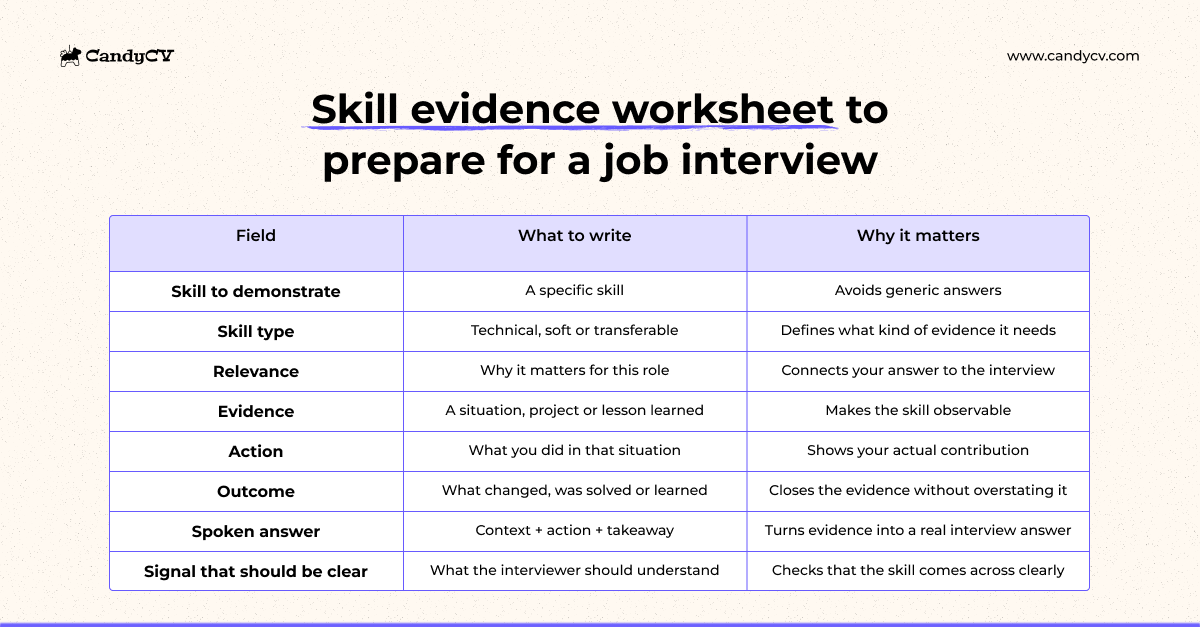
You will find the worksheet later in the article so you can apply this logic. It does not guarantee that you will move forward, and it cannot rescue weak evidence. But it can help you answer with more clarity, specificity and credibility.
What it means to demonstrate a skill in a job interview
Demonstrating a skill means helping the other person infer it from something observable: a decision you made, a specific action, a problem you solved, how you coordinated with others, something you learned and applied, or a signal that appears during the conversation.
This fits with how many structured or competency-based interviews are designed. The U.S. Office of Personnel Management describes structured interviews as a way to measure job-related competencies through systematic questions about past behaviors or hypothetical situations, evaluated with consistent criteria.
The difference may look small, but it changes the whole answer. “I’m a problem solver” is a label. “I noticed the process was getting stuck at one point, proposed two alternatives, validated the most realistic one with the team and adjusted the delivery plan” starts to show problem solving, judgment and your own action. And if you come from another industry or role, saying “I’m sure I can do it” is not enough. To transfer the skill, you need to explain what ability appears in the previous context, which part can reasonably apply to the new role and which part should not be assumed.
The next section turns this idea into four practical decisions: which skill to choose, what kind of proof it needs, what evidence to use and how to know whether that evidence helps or weakens your answer.
A method for turning a skill into interview evidence
To demonstrate a skill, start by deciding which skill matters, what kind of proof it needs and what evidence you can defend without exaggerating.
Choose the raw material first; decide how to explain it after. If you start with a framework like STAR, you may end up organizing an example very neatly even though it does not prove what the question needs.
Step 1: choose the skills that matter most for this role
You do not need to prepare every skill you have, just prepare the few skills that make sense for this specific interview.
A practical way to prioritize is to combine two signals:
- The job posting or job description, especially repeated requirements, core responsibilities, tools, deliverables or problems that appear more than once.
- The interview stage and the interviewer, because a first recruiter screen, a technical interview and a conversation with the hiring manager usually need different levels of detail.
If a skill does not connect with either signal, it probably should not be a priority for that upcoming conversation.
This is because skills do not live in the abstract. The European ESCO classification connects knowledge, skills and competences with occupations where they may be essential or optional; and O*NET, from the U.S. Department of Labor, describes occupations through tasks, work activities, knowledge, skills and abilities. In an interview, the same principle becomes practical: prepare evidence for what the role requires, not for everything you know how to do.
Step 2: identify what kind of skill you need to demonstrate
Not all skills are demonstrated in the same way:
- A technical skill usually needs signals of execution, judgment and use of a tool or process.
- A soft skill needs observable behavior.
- A transferable skill needs you to translate an ability from a previous context into the new role.
| Practical type | What you need to make visible | Evidence that usually works | Risk to avoid |
|---|---|---|---|
| Technical skill | Execution, technical judgment, a tool, a process, decision quality or problem solving. | Project, technical exercise, real case, process improvement, technical decision, analysis, error detected and corrected. | Stopping at “I know how to use X” or hiding behind jargon, tools or titles. |
| Soft skill | Observable behavior in a situation involving friction, coordination, communication, judgment or responsibility. | Team, client or stakeholder situation; conflict; prioritization; explaining something complex; adaptation; feedback; decision under pressure. | Using empty adjectives: “I’m a good communicator,” “I’m a team player,” “I’m proactive.” |
| Transferable skill | Which ability from a previous context can apply to the new role and why that inference is reasonable. | Experience in another industry, role, project, volunteer work, training, fast learning or a similar work pattern. | Treating transfer as automatic equivalence: “I haven’t done it, but I’m sure I can.” |
This distinction helps you choose better evidence, but it is not rigid. A transferable skill can also be technical or soft: you may have developed analytical judgment in a different industry, or client coordination in a role that does not look like the one you are applying for. What transfers is not the label. It is the part of the evidence that can reasonably apply to the new context.
Step 3: find the right evidence for that type of skill
Good evidence is specific, defensible and relevant to the role. It can come from work experience, an academic project, an internship, an informal responsibility you took on, a decision, a corrected mistake, a technical exercise, something you learned and applied, or a situation from another context with a reasonable transfer.
The University of Oxford’s careers guidance on demonstrating that you fit the job criteria emphasizes showing fit through evidence of the skills and qualities specified in the job description. Applied to an interview, that means a good example is not enough on its own: it has to help answer why that skill matters for this specific role.
The useful test is this: the evidence should show what you did, what judgment you used and what signal it leaves about how you work.
To find it, start where you already have raw material:
- Projects where you made a decision, removed a blocker or improved part of a process.
- Situations involving coordination, clients, teammates, pressure, ambiguity or conflicting priorities.
- Technical tasks where the interviewer can see not only the tool you used, but why and when you used it.
- Recent lessons learned that you can connect to a need in the role.
- Experiences from another industry or role that show an applicable pattern.
On a resume, a skill is usually compressed. In the interview, you need to defend it. If you are not sure your resume presents those skills clearly, review the guide on how to show skills on a resume.
Step 4: check whether the evidence is strong, weak or counterproductive
Before you turn evidence into an answer, check whether it actually demonstrates the skill or merely sits next to it. Strong evidence leaves a clear signal even if you do not keep repeating the skill label.
| Type of evidence | How to recognize it | What to do |
|---|---|---|
| Strong | It is specific, relevant to the role, shows your own action and closes with a result, lesson learned or observable signal. | Use it and adapt it to the specific question. |
| Weak | It stays at the label level, describes an achievement without explaining your role or uses an example so generic that anyone could tell it. | Add detail: situation, decision, your own action or what you learned. |
| Counterproductive | It inflates a metric, exaggerates impact, contradicts what the role needs or fails to answer the question. | Drop it or reformulate it with more honesty and a stronger connection. |
Some evidence sounds strong because it sounds big, but it falls apart when you look closely. A number without context can sound impressive and still fail to demonstrate the skill being asked about. A relevant project can fall short if your own contribution is unclear. A highly prepared story can become counterproductive if it answers a different question. Make sure the evidence is strong.
With these four steps, you have the raw material. The next step is to organize that evidence in a worksheet so you can connect it to the role and communicate it clearly in the interview.
A skill evidence worksheet for a job interview
This worksheet helps you turn a relevant skill into evidence you can defend in an interview. Use it for the skills you have prioritized for a specific interview with the method above.
Complete one row per skill. If you cannot fill in the evidence, your own action or the signal that should come across, your answer probably is not demonstrating the skill yet.
| Field | What to write | Why it helps |
|---|---|---|
| Skill I want to demonstrate | A specific skill, not an overly broad label. | Prevents you from starting with a loose story that does not answer the question. |
| Practical type | Technical, soft and/or transferable. If it is transferable, add where it comes from and what should not be assumed. | Forces you to choose the kind of proof the skill needs and avoids treating transfer as automatic equivalence. |
| Why it matters for this role | The role need, job posting, question or interview stage that makes it relevant. | Stops you from preparing a universal list of qualities with no connection to the interview. |
| Available evidence | A situation, project, decision, problem, exercise, lesson learned or transferable experience. | Turns the skill into something observable and defensible. |
| My own action | What you did: analyzed, proposed, coordinated, executed, corrected, learned or decided. | Separates your contribution from the broader context or the team’s work. |
| Result, lesson learned or observable signal | What changed, what was solved, what you learned or what behavior became visible. | Closes the evidence without forcing metrics or inflating impact. |
| How I would explain it in the interview | A brief version with enough context, your own action and a close connected to the question. | Turns the evidence into an oral answer without reducing it to a memorized sentence. |
| Signal that should be clear | The professional inference you want the other person to be able to make. | Checks whether the skill is understandable even if you do not repeat it as an adjective. |
Three examples: technical, soft, and transferable skills
These examples are directional. They are not meant to be copied as answers. They show how the evidence changes depending on the type of skill.
| Skill and type | Possible evidence | Your own action | Signal that should be clear |
|---|---|---|---|
| Data analysis applied to decisions (technical) | For a role where you need to turn operational information into decisions, an academic or professional project had scattered data and you needed to identify which variable was affecting an outcome. | You cleaned the available information, compared basic patterns, explained the limits of the data and proposed a cautious decision. | You do not just “know a tool”; you can reason with data, recognize limits and translate findings into a recommendation. |
| Communication with different audiences (soft) | For a role with nontechnical stakeholders, a teammate or client did not understand a technical explanation and that was blocking a decision. | You changed the level of detail, used a more familiar example, checked what was still unclear and adjusted the explanation. | Communication appears in the adaptation, not in saying “I communicate well.” |
| Prioritization from a different context (transferable) | For a role with competing demands, in another industry, an internship, volunteer work or customer-facing job, you had several requests and limited resources. | You ordered priorities, set expectations, asked for critical information and clarified what could be handled first. | The reasonable transfer is judgment under pressure; it does not automatically prove that you already master every task in the new role. |
Notice that none of these rows tries to be a complete story. The worksheet prepares the evidence. Then you will need to adapt it to the question you are asked: you will not explain a technical skill the same way to a specialist interviewer as you would in a first recruiter screen.
How to explain skill evidence without turning it into a canned answer
Evidence works in an interview when it answers the specific question with enough context, a recognizable action of your own, an honest close and a clear connection to the role.
A useful order is:
- Answer the question. If you are asked about communication, prioritization or technical judgment, start with that skill, not with your whole career history.
- Give only the necessary context. Explain just enough for the other person to understand the difficulty, goal or constraint.
- Make your action visible. Separate what the team did, what depended on other people and what you did.
- Close with a result, lesson learned or signal. Not every answer needs a number, but it does need to make clear what the evidence demonstrates.
- Connect it to the role. Add a short sentence explaining why that experience is relevant to the role you are interviewing for.
The right level of detail depends on the question and the stage of the interview. In a first screen, a compact version may be enough. In a technical or behavioral interview, you may need more detail about decisions, criteria or limits. In fact, in the tech hiring processes analyzed in Spain, insufficient technical depth was the most frequently recorded employer reason for rejection. The report explains what that pattern can and cannot tell an individual candidate. Your answer should be expandable or reducible without losing the main signal.
The risk of bringing an answer that is too closed is that you end up answering the sentence you prepared, not the question you were asked. If the interviewer asks for detail, go into your reasoning. If they ask for a summary, go to the signal. If the focus changes, adapt the evidence instead of forcing it.
A practical test: your evidence is ready to be explained briefly or fully if you can tell it in 30 seconds and in two minutes without changing the substance. If it only works as exact wording, it still depends too much on form.
If your blocker is not demonstrating a skill but interpreting a difficult, ambiguous or uncomfortable question, you can work on difficult interview questions and what they evaluate.
How to use STAR, CAR, PAR or SOAR without making them the method
STAR, CAR, PAR or SOAR can help you organize evidence, but they should not decide which skill you choose or which example you use. The most important part is choosing strong evidence. After that, use the structure that feels most useful for explaining it clearly.
The logic is similar across these frameworks:
| Framework | How it helps | Limit |
|---|---|---|
| STAR | Organizes situation or task, action and result. | Can become rigid if you use it as a closed script. |
| CAR | Organizes context, action and result. | Can fall short if you do not explain what you learned or how it connects to the role. |
| PAR | Starts with a problem, then action and result. | Not every skill is best demonstrated as a “problem solved.” |
| SOAR | Adds an obstacle or challenge before action and result. | Can dramatize simple evidence if you force the obstacle. |
OPM’s guidance on creating structured interview questions mentions STAR as a way to gather situation or task, action and result when asking open-ended competency-linked questions. That supports its value as an organizing structure, but it does not make it a guarantee. University guidance from the University of Glasgow and Queen’s University Belfast also emphasizes choosing specific examples, avoiding generic answers and making your own action clear.
So use these frameworks as a guide, not as the protagonist. If you want to demonstrate technical judgment, the framework can stop you from getting lost in detail. But the answer will still be weak if the interviewer cannot understand what decision you made, what alternatives you considered or what limit you recognized. If you want to demonstrate communication, STAR can organize the situation, but the skill appears in how you adapted the message, checked understanding or handled friction.
It also helps to close the framework with a sentence that connects the evidence to the role, such as: “That is why I think this experience fits a role where I would need to explain complex information to nontechnical stakeholders,” or “That situation is relevant to an environment with changing priorities where decisions often have to be made with incomplete information.”
If the framework forces you to add irrelevant parts, cut it down. A clear answer can skip the label and still work if it makes the context, your own action, result or lesson learned and relevance to the role visible.
What to say when you do not have clear numbers
Not having a metric does not automatically invalidate your evidence. What weakens it is inventing numbers, inflating impact or closing with a result you cannot defend.
Quantify when the data exists, is relevant and you can explain it with context. If you contributed to a measurable improvement, a time reduction, a quality increase or a delivery with calculable indicators, it may make sense to mention it. If you do not know how the number was calculated or what part depended on you, do not use it as the main close.
But “always quantify” is a bad rule: some skills are shown better through a decision, responsibility you took on, a difficult conversation, something you learned and applied or a way of working.
When you do not have clear numbers, you can close the evidence with honest alternatives:
- Qualitative result: what changed in how people worked, coordinated, decided or delivered.
- Responsibility you took on: what part depended on you and how you handled it.
- Applicable lesson: what you learned and how you would use it in a similar context.
- Judgment used: what you prioritized, what you ruled out and why.
- Observable signal: what behavior became visible to others: clarity, adaptation, autonomy, precision, listening or the ability to ask for context.
The point is to close the evidence with something defensible, cautious and connected to the role. If the result was small, keep it small. If it was shared, separate your contribution. If it was a lesson, explain how it changes the way you work.
Once the evidence is organized, there is one more layer: some skills are also demonstrated while you talk, listen, clarify limits and adjust the level of detail. That does not replace prepared evidence, but it can reinforce or weaken it.
Skills you also demonstrate while you talk in a job interview
In an interview, signals also appear in how you listen, clarify, reason, adjust the level of detail and recognize limits.
That does not replace evidence: if you say you communicate well, prioritize with judgment or learn quickly, it is still better to have a concrete example. But the way you hold the conversation can reinforce or weaken that example. A solid answer loses force if you do not listen to the question, answer something else or treat every clarification as a defense.
These are the signals to pay attention to:
- Listening. You answer what was asked, not the answer you brought with you. If needed, you confirm the focus before starting: “Are you asking more about the technical side or about how I coordinated it with the team?”
- Clarity. You explain the context without turning it into an endless story. The other person quickly understands the problem, what you did and why it matters.
- Adaptation. You adjust the level of detail depending on who is asking. You do not explain a technical decision the same way to a specialist as you would to someone assessing general fit.
- Judgment. You do not only say what you did; you explain why you chose one option, what you ruled out and what limitation you saw.
- Recognition of limits. You do not turn a small experience into a major win or pretend to have mastered something you are still learning. You can say: “I know that part at a practical level, but I have not led it end to end yet.”
- Relevant questions. When appropriate, you ask just enough to better understand the role, priority or context before answering. That can show judgment, not just interest.
The goal is to make it easier for the other person to see how you think and work. When the interview allows some exchange, a skill can be observed both in the example you choose and in how you explain it, qualify it and connect it to the role.
Next step: practice your interview evidence out loud and choose the right route
Once you have prioritized the skills, chosen defensible evidence and structured how you would explain it, practice it out loud. An interview is an evaluative, high-pressure context, and communication changes a lot when it moves from writing to speaking.
If you want to test how that evidence holds up in a full conversation, you can take a mock interview based on your resume and the job posting. You will answer questions and follow-ups out loud, then use the report to review whether your examples show your own actions, outcomes and connection to the role. Treat it as a test of your evidence, not a verdict on your application.
From there, use the route that matches where you feel stuck:
- If you need to organize the whole interview (job posting, role signals, examples, practice and feedback) go to the end-to-end method for preparing for a job interview.
- If your problem is a specific, difficult or ambiguous question, work on difficult job interview questions and what they evaluate.
- If you want to simulate a conversation with AI, explore the criteria for practicing your interviews.
- If the same problem keeps repeating after several interviews and you are not sure where the process is failing, review the most common job interview preparation mistakes.
The worksheet does not promise that you will move forward after an interview or compensate for a poor fit with the role. Its value is narrower and more useful: it helps you arrive with your own relevant, honest evidence and explain it so the skill can be seen through actions, decisions, lessons learned and signals during the conversation.