How to choose a good resume builder: a practical evaluation method

A resume builder should not be evaluated by the number of templates it offers, its design options, or its promises about AI and “ATS optimization.” None of that proves, on its own, that it actually helps you create and maintain a resume that works well in modern hiring processes.
This is what you should check before investing time or money in one.
This guide gives you a 4-criterion method for evaluating any resume tool based on the effect it has on the resume you produce and the effort it takes to keep working on it afterward.
A genuinely good resume tool should help you create a resume that is:
- technically usable in modern job application environments,
- built around clear, relevant, non-generic content,
- easy to edit, maintain, and tailor,
- and free from product mechanics that make you lose time, money, or judgment.
Here is the logic of the method, with the four criteria and the possible conclusions. The rest of the article develops each one.
| Criterion | Critical failure | Important limitation | Good execution |
|---|---|---|---|
| Technical usability of the resume | The output seriously compromises how the resume works in ATS, job boards, or other application environments | It can work, but it is fragile or frequently restricted | It creates a technically solid resume by default |
| Content quality | It pushes you toward generic, superficial, or misleadingly “optimized” content | It allows good content, but does little to help you create it | It helps you prioritize, phrase, and focus your content without replacing your judgment |
| Ease of editing and maintenance | Editing the content takes so much time that it discourages updates and tailoring | Editing is possible, but slow or unintuitive | It makes the resume easy and fast to edit, maintain, and adapt |
| Product reliability and integrity | It uses deceptive patterns: hidden costs, forced subscriptions, poor portability | The business model is not very transparent, but there are no serious traps | Pricing is clear, the business model is fair, and the resume can be used outside the tool without artificial friction |
Possible conclusions after the evaluation:
- Suitable and solid: the tool performs well across all four criteria and has no critical failures.
- Suitable but limited: it does not fail in a serious way, but it has limitations that reduce its value and the quality of the resumes it helps create.
- Not recommended: it has one or more critical failures that compromise the result and, therefore, your job search.
And if you are still exploring the different types of tools available, start with our guide to resume tools: what types exist and how they differ.
How to evaluate a resume builder: method explained
This method does not judge a resume tool by its price, popularity, Google ranking, or promise to make the process faster. All of that may affect your final decision, but it does not predict the quality of the result.
To evaluate a resume tool properly, we will focus on 4 quality criteria:
- Technical usability of the resume: whether the resume created by the tool can work properly in modern technology-driven application environments, including ATS, job boards, and LinkedIn.
- Content quality and focus: whether it helps you build a clear, relevant, well-prioritized resume, or pushes you toward generic, superficial, poorly focused content.
- Editing, maintenance, and tailoring with a good effort-to-value ratio: whether working on the resume is efficient and sustainable, or whether every meaningful change costs too much effort.
- Product reliability and integrity: whether the tool is designed to genuinely help you, or to capture your time, money, or decisions while giving the impression that it is helping.
Each criterion covers a different way a resume builder can fail without you noticing at first. Together, they answer one question:
Does this tool truly improve the resume it produces and the process of working on it, or does it simply make it easier to format something and feel like progress is happening?
That is why we will not use a binary “works” or “doesn’t work” judgment for each criterion. We will distinguish between three levels:
- Critical failure: the tool fails in a way that invalidates or seriously weakens its value as a basis for creating your resume.
- Important limitation: the tool is not completely disqualified, but its usefulness is significantly reduced and it may hold you back more than it seems.
- Good execution: the tool fully meets the criterion and does not force you to compensate for its weaknesses with more time, more effort, or worse decisions.
These criteria can be used to evaluate a word processor like Word, a design tool like Canva, a dedicated resume builder, or an AI chat.
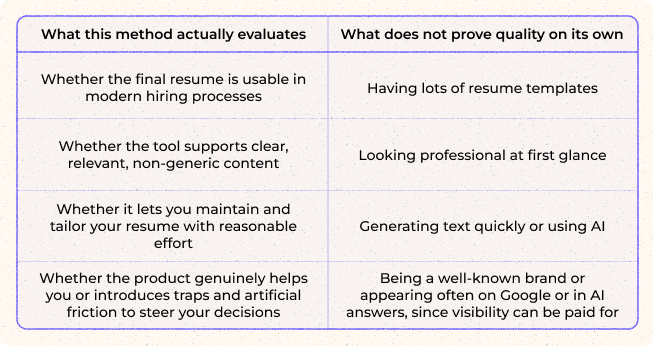
From here, we will apply the method criterion by criterion.
Criterion 1: Does the tool create a technically usable resume for ATS and online applications?
A technically usable resume, or “ATS-friendly resume” is one that the technology involved in a hiring process can read, process, and reuse properly: ATS, job boards, online application systems, and even environments like LinkedIn.
If you need a fuller explanation, read: what an ATS is and how it affects your job search.
This criterion comes first for a simple reason: if the tool creates a resume with a fragile technical foundation, everything else loses value. It does not matter that the design looks good or that the content is strong if the document does not move well through the environments where it will actually be submitted.
A good tool should generate a resume that is readable, interpretable, and usable in modern hiring processes.
The problem is that many tools use this need as a sales hook without really solving it. They talk about “ATS-friendly templates,” “AI ATS optimization,” or even a supposed “ATS score” as if technical compatibility could be reduced to choosing a specific template, changing a few words, and uploading the resume until the score goes up.
That oversimplifies the problem so much that it stops addressing the real technical usability of the resume.
The red flag is not that a tool uses these terms. The red flag is that it uses them as the main sales argument without explaining what it actually guarantees, how it solves the issue, or how you can verify it.
If a tool promises ATS compatibility but only “adapts keywords to a job posting,” increases a score, or adds “ATS” to the name of its templates, it is not a trustworthy tool.
For this criterion, the evaluation is:
| Level | What it means |
|---|---|
| Critical failure | The tool creates resumes whose technical usability is seriously compromised. The result may look good, but it loses the ability to be processed, understood, or reused correctly in application environments. |
| Important limitation | The tool does not completely break the resume, but it leaves it fragile. It may work in some contexts, but with frequent restrictions or too much dependence on everything going perfectly. |
| Good execution | The tool creates a technically solid resume by default, with a structure that is reasonably interpretable and usable in ATS, job boards, and other application environments. |
Criterion 2: Does the tool help you create strong resume content, or does it push you toward a generic resume?
This criterion evaluates whether the tool actually improves the content of the resume or only makes it sound better.
That difference matters a lot because a resume works when it helps someone quickly understand who you are, what you can do, and what problem you can help solve.
So the question is not only whether the tool can rewrite what you give it. The question is whether it helps you make better decisions about what to say, what to prioritize, and how to position your profile.
Many tools now offer AI content assistance: they rewrite bullet points, add words from a job posting, or generate entire sections. The result often sounds more professional than the original text, but that does not mean the resume has improved. In fact, it may make it worse.
Good resume content does not come from rewriting. It comes from decisions.
What deserves to be included? What should be left out? What matters most? How does one experience connect with a target role? How should transferable skills be explained when someone has a non-linear career path?
Most tools that use AI for resume content operate on the text you already provide, without questioning those decisions or helping you make them. They help you write better, but not think better.
When a tool only generates text, rewrites phrases, inflates narratives, or swaps words for more “appropriate” ones, but does not help you understand your profile better or prioritize with judgment, the improvement is only apparent.
The red flag is not that a tool uses artificial intelligence, but presenting AI as the solution to the content problem without distinguishing between improving the wording and improving the value of the resume.
As with “ATS optimization” in the previous criterion, AI is often used as a commercial hook. It promises to help with your content, but in practice it gives you a more polished version of the same weak decisions.
If you want to go deeper into this distinction, read our guide to the different types of resume tools.
For this criterion, the evaluation is:
| Level | What it means |
|---|---|
| Critical failure | The tool actively pushes you toward poor, generic, or superficial content. The user ends up with a more presentable resume, but the underlying problem remains the same or gets worse. |
| Important limitation | The help stays at the surface level: it corrects, rewrites, or inserts words, but barely helps with prioritization, focus, or deciding what deserves to be included. |
| Good execution | The tool helps you structure, prioritize, and phrase your content better without replacing your judgment. It does not generate content without good context or push you toward phrases that could apply to anyone. It makes it easier to think clearly, not avoid thinking. |
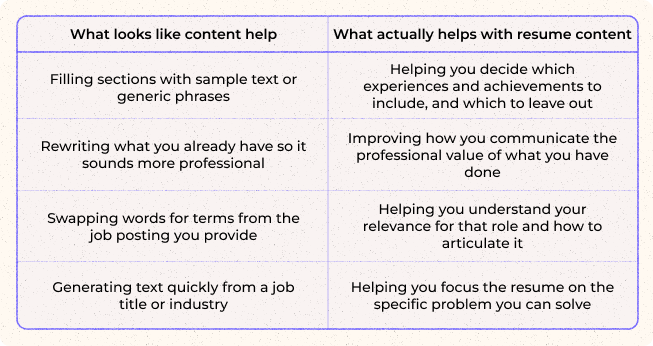
Before moving to the next criterion, it is worth saying that part of the problem comes from a mistaken expectation on the user’s side: the idea that resume content can be delegated.
It is the one part of the process that requires decisions nobody else can fully make for you. An AI tool can help you structure or phrase your experience better, but do not expect it to know what to write and how to frame your professional narrative.
If you let it do that for you, it will turn you into a clone of every other resume it generates.
Criterion 3: Can you edit and tailor your resume without wasting more effort than it is worth?
A resume builder should not be judged only by whether it lets you create a first version. It should also be judged by how easy or painful it will be to work on that resume afterward.
In practice, a resume is not written once and then left alone. It gets corrected, updated, tailored, and turned into multiple versions. But this criterion is not just about “easy and fast editing.” It is about the effort-to-value ratio.
A good tool should not force you to spend time and energy on low-value tasks, such as pointless design decisions or fighting with a template every time you touch the content. The harder it is to edit, update, and tailor your resume, the less you will do it. And if improving your resume or adapting it to specific opportunities becomes too costly, your job search suffers.
The clearest signs of good execution usually look like this:
- You can edit the content directly on the template, seeing the result as you work, instead of being forced through forms that separate you from the final document.
- The template adapts to the text without breaking, so changing content does not force you to manually reposition or repair the layout.
- Creating and managing versions is simple, so tailoring your resume to different roles or job postings does not mean almost starting over.
A clear example is a Word-style resume template: it keeps a clean, familiar, document-like look, but you edit it in an environment designed for resumes instead of working on a manual layout in Word.
The problem appears when the tool depends too much on layout manipulation or manual adjustments. At that point, editing stops being resume improvement and turns into a fight with the document.
You can usually spot this when:
- the design breaks when you change the content;
- you need to add invisible boxes, columns, or layout tricks to make the document behave;
- you cannot immediately see how your edits affect the final result;
- duplicating a version creates more work instead of saving it;
- or the tool pushes you to spend time on visual details that do not meaningfully improve the resume.
This is where design tools like Canva or word processors like Word can be more harmful than they first appear.
You can learn more about those tools here:
- Resume templates in Canva: why they fail and what to use instead.
- How to make a resume in Word with strategy and when to use another tool.
For this criterion, the evaluation is:
| Level | What it means |
|---|---|
| Critical failure | Editing, maintaining, or tailoring the resume takes so much effort that the tool ends up discouraging important improvements. Working on the document becomes a constant source of friction. |
| Important limitation | The resume can be edited and maintained, but with too many steps, poor usability, or enough wasted time to significantly reduce the tool’s real value. |
| Good execution | The tool lets you edit, update, and create versions in a stable, reasonably fast, low-friction way, without forcing you to spend excessive energy on low-return tasks. |
This criterion also matters because a good effort-to-value ratio helps solve a barrier that is increasingly important: tailoring your resume to different opportunities. Not because the tool has to do that work by itself, but because sustainable tailoring requires reducing the operational friction of maintaining, adjusting, and duplicating versions.
If this matters to you, read our guide on how to tailor your resume to a job posting without rewriting it from scratch.
Criterion 4: Can you trust how the resume tool works and how it charges you?
Here we evaluate not only the output, but the reliability and integrity of the product.
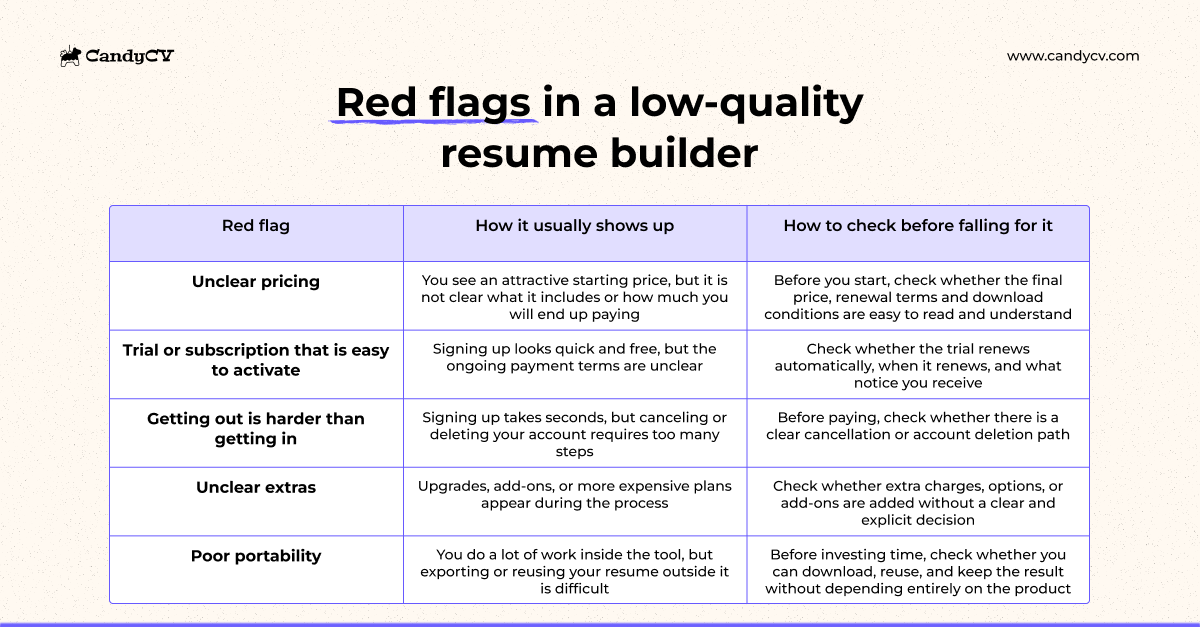
Users of resume builders often complain about unclear pricing, confusing subscriptions, and misleading value propositions. Look at the reviews Google shows for many resume tools and you will see the pattern. If you want to avoid falling into those traps, this criterion will help.
The good news is that the warning signs are usually easy to recognize:
- Hidden costs: the real price is not clear until the end, or charges appear that were not obvious at the beginning.
- Trials or subscriptions that are too easy to activate and then difficult to cancel.
- Cancellation or account deletion processes that are unnecessarily complicated.
- Excessive customization: the tool gives you endless design, layout, and styling options that make you spend more time tweaking than improving the resume.
- Poor portability: you can spend a lot of time building your resume inside the tool, but exporting it, reusing it, or working on it elsewhere becomes difficult.
There is nothing wrong with a tool charging for the service it provides. The question is whether it charges clearly and supports an informed decision, or whether it relies on keeping you inside long enough that leaving feels more costly than paying.
For this criterion, the evaluation is:
| Level | What it means |
|---|---|
| Critical failure | The tool introduces clear product traps: hidden costs, subscriptions that are difficult to stop, artificial exit barriers, or a level of dependency that distorts the user’s decision. |
| Important limitation | There is no serious trap, but there is low transparency, unnecessary friction, or poor portability that significantly reduces trust and product value. |
| Good execution | The product is clear about pricing and terms, does not introduce artificial barriers, and gives you a reasonable sense of control over your account, your payment, and your resume. |
How to apply this method to any resume builder
The four criteria are now clear. The only thing left is knowing how to use this method to choose a good resume tool.
Here is the decision logic:
- If you detect even 1 critical failure, discard the tool.
- If there are no critical failures, but there are 2 or more important limitations, the tool is not completely disqualified, but you already know it is a weak foundation and will not give you the best result.
- If there are no critical failures and at most 1 important limitation, the tool can be considered suitable.
- If all 4 criteria are well executed, you are looking at a good tool for creating your resume.
To make this easier, you can fill in a table like this with the tool you are evaluating:
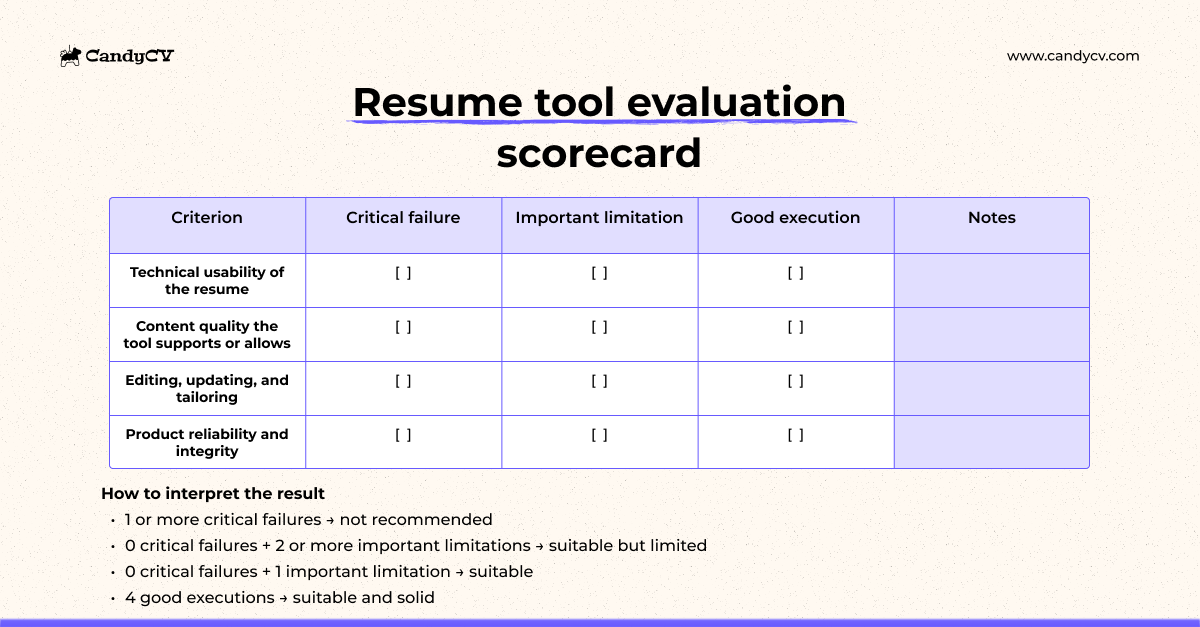
Then interpret the result like this:
| Result | What it means | What to do |
|---|---|---|
| 1 or more critical failures | The tool fails in something too important to trust it as your foundation | Discard it and stop investing time in it |
| 0 critical failures + 2 or more important limitations | It may seem good enough, but it will hold you back in relevant areas | Use it only as a temporary solution or look for a better alternative |
| 0 critical failures + 0–1 important limitation | The tool is suitable as a foundation | You can keep using it |
| 4 criteria with good execution | The tool is not only suitable, but solid | It clearly deserves your trust |
If applying this method shows that your current tool does not pass the test, the next step is to review which options do. In our guide to the best resume builders, you will find a selection of the 3 tools that best pass this same method, with their strengths and limitations analyzed using the same criteria.
Conclusion: a good resume tool is not the one that does the most, but the one that holds you back the least
After this whole method, the point is not whether a tool has more features, more templates, or more promises.
The important question is whether it helps you build and maintain a better resume, or whether it forces you to compensate for its weaknesses with more time, more effort, and worse decisions.
A bad tool is not always obvious right away. Sometimes it lets you produce an “acceptable” resume, but:
- it pushes you toward generic content;
- it makes tailoring versions harder;
- it sells technical compatibility as a slogan;
- or it traps you in a product that seems more helpful than it really is.
That is why choosing a resume tool should not be about familiarity, design, or marketing. It should be about the quality of the result it helps you build and the cost it imposes to keep that result useful.
If this article made you realize your current tool is holding you back more than it helps, try CandyCV. It is designed to help you create a resume that is technically usable, easy to edit and tailor, and less dependent on design tricks or AI-inflated text.