Practice job interviews with AI: what makes a good simulation

Practicing job interviews with AI means rehearsing before the real interview in a conversational simulation, ideally out loud. You should not expect for it to provide you with the right answer; instead, use it to check whether you can make a clear case for yourself as a candidate: what you said, how it came across, what needs more detail, which example supports your point and what you should repeat differently.
This article gives you the criteria you need to tell whether AI interview practice is actually preparing you for a real interview or just giving you a false sense of control.
If you still do not know what you want to prove, which examples you will use or what the role may evaluate, do not start with the simulation. Start by learning how to prepare for a job interview, then come back to AI once you have real material to work with.
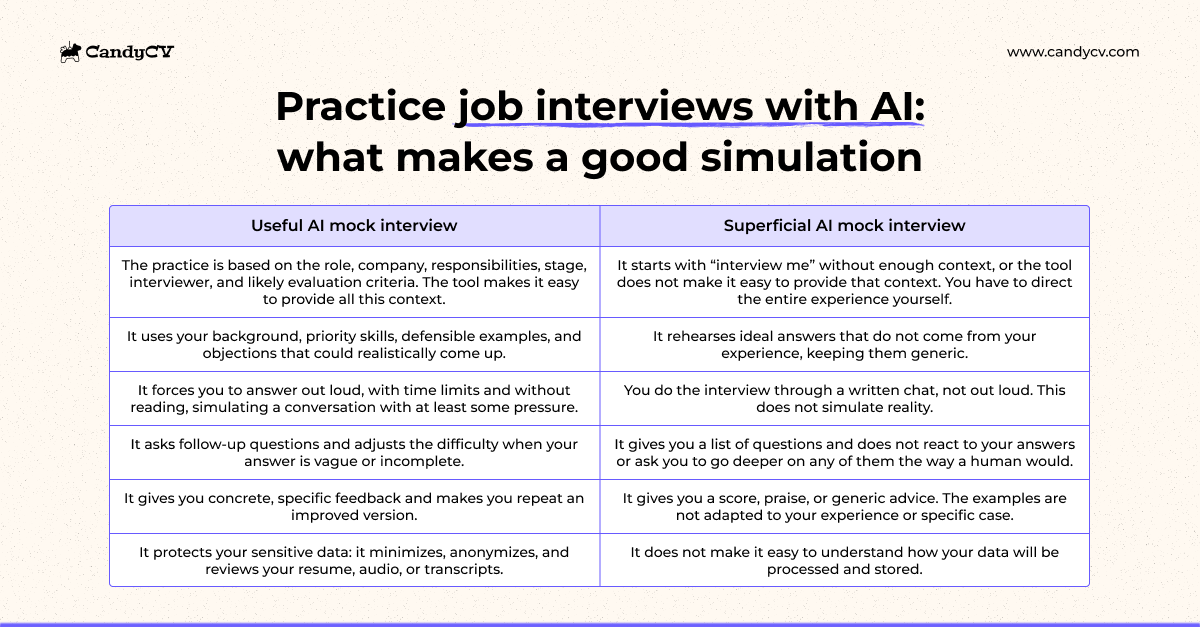
This matrix is a preview of the full diagnosis. Use it to detect whether the practice is training a realistic conversation or only reproducing a pattern of generic questions, written answers and feedback that sounds good but changes nothing.
A good simulation turns the context of the role into a practice conversation, with feedback you can question and repeat without exposing more data than necessary.
When practicing job interviews with AI helps and when it creates false confidence
AI interview practice helps when it turns a future interview into something you can observe and improve. You do not need AI to predict what the company will do or what the interviewer will ask. It'd already be helping you a lot if it checked whether your answer sends the right signals, is easy to understand, connects with the role and is grounded in relevant examples.
Exploratory research on interview-practice prototypes using language models points to that kind of value: a lower-pressure conversation, follow-up questions, back-and-forth feedback and the chance to revisit an answer. It also shows limits: AI can be too positive, sound objective without being objective or fail to reproduce the pressure of a real interview.
It starts creating false confidence when the session is too comfortable. If the tool you use for practice asks generic questions, accepts any answer, praises you without pointing to anything specific or reduces everything to a score, you may feel as if you practiced a lot without training the hard part: explaining your experience clearly under the reasonable pressure of an evaluative conversation.
That is why, before you simulate, you need to prepare the starting information that keeps the session from turning into a generic chat.
What information AI needs to simulate a realistic job interview
Before asking AI to interview you, you need to give it enough context. Enough does not mean pasting your entire resume or sharing personal data. It means *giving it the material that shapes the conversation: role, interview stage, interviewer, likely criteria and your background as a candidate.
If you start with “interview me,” even if you paste a job posting and your resume, the tool will probably fill the gaps with typical questions and general feedback. To practice better, prepare a reduced and safer version of these 10 context pieces:
- Information about the role and the company.
- Main responsibilities from the job description.
- Expected seniority and stage of the process: recruiter screen, technical round, final interview, and so on.
- The interviewer’s likely role or roles.
- Likely criteria they may assess: experience, skills, communication, leadership, technical judgment, culture fit or role fit.
- A summary of your relevant background and priority skills. If you struggle to turn skills into proof, review how to demonstrate skills with evidence in a job interview.
- Three to five examples that show fit or impact and that you can talk through out loud.
- Concerns, weak spots or questions you already know you want to practice.
- How you want feedback and follow-up questions to work, and whether you want them to focus on something specific.
- Data limits: what you will not share and what you prefer to anonymize.
This matters because an interview does not evaluate you in the abstract. It usually tries to check whether your experience, examples and reasoning fit a specific role. The McDaniel et al. meta-analysis on the validity of employment interviews helps explain why content, structure, interview type and evaluation criteria matter. If AI does not know which role you are preparing for, which stage you are in or which criteria may be at play, it is not simulating a realistic interview. It is reacting to an incomplete conversation.
That is also why guidance on structured interviews emphasizes role-related questions, clear criteria and consistent evaluation, as explained by GOV.UK in its guidance on fair and structured interview techniques, Google re:Work in its structured interviewing guide and Civil Service Careers when discussing preparation with examples from the job description.
That said, the Spanish Data Protection Authority recommends extreme caution when entering personal or sensitive information into AI tools. Apply that caution from the first input: summarize, reduce and anonymize before sharing.
Checklist: how to know whether AI interview practice is useful
Use the following criteria to check whether the experience trains a realistic conversation: with context, appropriate difficulty, feedback you can review, repetition and data limits.
| Criterion | What it checks | Useful AI practice | Superficial AI practice |
|---|---|---|---|
| Role context | Whether the simulation understands the situation you are preparing for. | Uses the role, company, responsibilities, seniority, interview stage and interviewer role. | Starts from “interview me” or from a description that is too general. |
| Likely criteria | Whether the practice is oriented toward what may be assessed. | Works with explicit criteria: experience, skills, communication, leadership, technical judgment, culture fit or role fit. | Asks typical questions without distinguishing which signals matter for that role. |
| Candidate background and evidence | Whether the answers come from your real experience. | Uses your relevant background, priority skills and three to five examples you can back up. | Generates ideal answers that sound good but are not grounded in your facts. |
| Practice focus | Whether the session has a clear target. | Includes concerns, weak spots, expected feedback type and focus for follow-up questions. | Practices generically, without addressing what is actually difficult for you. |
| Voice and pressure | Whether it trains conversation, not just writing. | Makes you answer out loud, with limited time, without reading and with real pauses. | Lets you write perfect answers in a chat and review them as text. |
| Realistic follow-ups | Whether AI reacts to what you say. | Asks for examples, data, clarification and specificity when your answer is vague. | Runs through a list of questions without adapting the conversation. |
| Adjusted difficulty | Whether the level of challenge fits the role and stage. | Adjusts tone, depth and difficulty based on the role and the stage of the process. | Everything sounds friendly, generic or too easy. |
| Actionable feedback | Whether the comment helps improve a specific answer. | Points to a phrase, the problem, its impact and the change to try. | Says “good answer,” gives generic tips or scores you without explaining the criteria. |
| Iteration | Whether the practice ends in a better second version. | Makes you repeat the answer and compare the first version with the improved one. | Ends with a score, report or comment without a plan for improvement. |
| Patterns | Whether it detects habits across answers. | Identifies vagueness, excessive length, lack of examples, defensiveness or weak role fit. | Evaluates each answer in isolation without finding patterns. |
| Privacy | Whether the session respects your data limits. | Minimizes and anonymizes; reviews use of resume, audio, transcripts and third-party data. | Accepts full resumes, sensitive data or confidential information without reviewing conditions. |
| Next action | Whether you know what to do after practicing. | Ends with what to practice next and why. | Ends with a vague feeling of confidence. |
If the matrix fails mostly on context and examples, go back to the base interview preparation. If it fails on voice, follow-ups or feedback, you may have a list of possible questions, but not a full simulation. If it fails on privacy, do not keep adding information: reduce, anonymize and review the tool’s conditions before continuing.
Speaking out loud changes what you are practicing
If you write an answer in a chat, you are training writing. That can help you organize ideas, find a structure or detect sentences that are too long, but it does not reproduce what happens in an interview: hearing a question, thinking with little time, speaking without reading, holding the thread and correcting yourself when you drift.
Speaking out loud changes the difficulty because it exposes things text hides: filler words, silence, overexplaining, weak endings, defensive tone or an answer that looked clear in writing but becomes confusing when spoken. The point is to check whether you can explain your experience naturally, specifically and understandably under moderate pressure.
A common counterexample: you write a polished answer about leadership, with structure and carefully chosen words. When you say it out loud, you take too long to reach the example, mix two situations together and make it unclear what you personally did. The written version was not useless, but it was training a different skill.
To practice better, avoid reading a prepared answer. Use minimal notes: role, example, outcome and the signal you want to communicate. If getting to that point is hard, use this guide to prepare for job interviews without memorizing answers.
Follow-up questions separate a realistic simulation from a list of questions
A list of questions helps you anticipate topics, but it does not reproduce an oral conversation. In an interview, the other person reacts to what you answer. A simulation starts becoming useful when AI does that too: if you say something vague, it asks for an example; if you claim an achievement, it asks about your contribution; if you use a generic phrase, it asks for a concrete situation; if the role requires more depth, it increases the difficulty.
Follow-up questions also prevent another problem: memorization. When AI changes the angle, asks for specificity or introduces a reasonable objection, memorized phrases stop working. Research on virtual interviewers and generated follow-up questions, such as Inoue et al. on elaborated follow-up question generation, points in that direction: follow-up questions are an important part of the conversation.
That difference matters because many interviews do not break down on the first answer. They break down when the interviewer asks for more detail. If the AI you use never asks for proof, data, priorities, examples or clarification, you are doing partial practice.
If your blocker is a specific difficult question (for example, explaining a layoff, a career change or a weakness) work on that question before running a broader simulation with the guide to difficult interview questions and what they may assess.
Useful feedback points to something specific and makes you repeat
Useful feedback points to a phrase, detects a pattern or identifies a specific absence, explains the problem it creates and proposes an action you can try in the next version. It should help you answer better, not just make you feel that someone has “reviewed” your answer.
One practical way to ask for it is:
“Point to one specific phrase in my answer that was vague, too long or weakly connected to the role. Explain the impact and tell me what change I should try in a second version.”
That kind of request forces AI to move from general advice to observations you can review. Even then, do not treat the feedback as final truth. Recent work on using language models to analyze interview transcripts, such as Maity et al. on HURIT, suggests that these models may approximate some evaluations, but they still have limits in detecting errors and offering specific, actionable feedback.
Signs of poor feedback
- It does not illustrate the point with specific phrases from your answers.
- It is so generic that it could apply to any candidate.
- It relies on a score but does not explain the criteria.
- It proposes an alternative answer that does not come from your experience.
- It does not connect the improvement to the role, stage, interviewer and question.
- It changes your message so much that it sounds artificial, exaggerated or unlike you.
If the AI feedback keeps saying that you lack examples, achievements or proof of a skill, the next step is not to repeat the same simulation ten times. First, you need to build evidence and then practice how to explain it.
Practice improves when the cycle leaves a trail: what answer you gave, what pattern appeared, what adjustment you tried and what you will do differently next time. But before you pile up recordings, transcripts or resumes inside a tool, review another criterion: privacy and limits of trust.
Privacy and limits you should not delegate to AI
Privacy affects whether AI interview practice is safe and useful. If practicing requires you to paste more data than necessary, or share audio and transcripts without reviewing the conditions, the experience already starts with a trust problem.
AI does not need your full resume, government ID, home address, client names, confidential information from past employers or third-party data to help you practice an answer. It needs a sufficient and controlled version of the context: role, responsibilities, level, interview stage, anonymized examples and the points you want to train.
The Spanish Data Protection Authority recommends reviewing terms and data protection information when using AI chatbots, as well as avoiding personal or sensitive information that is not necessary.
Before practicing, follow these steps:
- Reduce: use a summary of your background instead of pasting your full resume.
- Anonymize: change names of companies, clients, people, sensitive projects and exact figures when they are not essential.
- Separate: do not mix personal, medical, family, financial or contractual information into an interview simulation.
- Review conditions: check what is stored, who can access it, whether conversations are used to improve the service and whether you can delete history or files.
- Be careful with voice: an oral conversation can generate audio, a transcript or both; do not assume they disappear just because you cannot see them.
- Challenge the feedback: if AI scores your answer or gives you a verdict, ask for the criteria and check whether they fit the job posting and your real experience.
The other limit is false authority. AI can sound confident, structured and convincing even when it simplifies, invents details, biases the feedback or fails to understand the context of a specific company. The NIST Generative AI Profile covers risks such as confabulation, bias, privacy and overreliance on generated responses. Translated to interview practice: a well-written explanation does not make the feedback true.
That is why any score, rating or diagnosis should be treated as a signal you can review. It cannot assure you that a company would select you or that your answer would work the same way with a human interviewer.
Which way of practicing fits what you need to train
Not every form of practice trains the same thing. The decision should not start with “which tool should I use?” but with “what do I need to train?”
| If you need to… | This may help… | Watch out for… |
|---|---|---|
| Anticipate common topics | Question lists | Turning them into passive reading or memorized answers. |
| Practice many times with low friction | General-purpose AI | You have to design context, difficulty, follow-ups, feedback and privacy yourself. |
| Simulate a more guided experience | Dedicated AI interview practice tools | Confusing scores or reports with objective evaluation. |
| Work on pace, clarity or filler words | Oral communication or speech coaching tools | Staying only at the delivery level and forgetting role fit, evidence and substance. |
Question lists and interview answers: when they help and when they fall short
Question lists and model answers help you anticipate topics: motivation, experience, conflict, strengths, weaknesses, compensation, job changes or fit with the role. They are useful for inspiration, but they fall short if you memorize them as written or only read them without preparing your own answers.
Their risk is false familiarity. Because you have seen the question before, it feels prepared. AI can help you generate a list or see examples, but it cannot do the actual work for you.
General-purpose AI is useful to practice job interviews only if you design the experience around the criteria
A general-purpose AI tool like ChatGPT or Gemini can ask questions, maintain a conversation, ask for examples, help you review an answer and let you repeat the same answer with adjustments. It makes sense if you do not have access to a dedicated interview simulation tool or if you want to start speaking out loud with less pressure.
The problem is that, by default, you have to design the experience. You have to decide what context to provide, which data not to share, what role the tool should take, which level of difficulty to request, when to demand follow-up questions, how to avoid flattering feedback and how to turn an observation into a better second answer. That is why it helps more when you already know how to prepare for an interview than when you need structure. If you want a more specific routine for ChatGPT, prompts and use limits, use the guide to using ChatGPT, Claude or Gemini to prepare for an interview without generic answers (it includes prompts).
What you cannot fully control, because these tools are not designed only for interview simulation, is their configuration and conditions before you upload sensitive data: files, voice or transcripts.
That distinction also matters in the Spain-specific data: the report on recorded AI-related reasons for rejection in tech hiring processes explains why being able to defend your own work matters more than simply using or avoiding AI.
Dedicated AI mock interview and simulators: use criteria before rankings
Dedicated AI interview practice tools can provide a more guided experience: voice, role-based questions, job posting or resume upload, follow-up questions, reports, communication metrics, progress tracking or per-answer feedback. If well designed, they can reduce the burden of building the whole session from scratch.
But being dedicated does not automatically make a tool good. It does not matter how many features it has if it fails the criteria a simulation needs to meet. First understand what good practice requires; then compare which tool solves it better.
The useful part is not treating the report as an objective evaluation, but reviewing where your answers lose clarity, evidence or connection to the role and deciding what to practice next.
What AI job interview practice can and cannot promise
With all of the above in mind, these are the limits to keep clear before practicing job interviews with AI tools:
| What we can reasonably say | What we should not promise |
|---|---|
| AI practice can help you repeat answers, speak out loud and detect vague responses if the session is well designed. | That practicing with AI increases your chances of being hired. |
| Follow-up questions and back-and-forth feedback can make practice more useful than a question list. | That AI reproduces the pressure, internal criteria or comparison with other candidates in a real hiring process. |
| Structured simulators have shown positive results in studies with specific populations and contexts. | That any AI tool will produce the same results. |
| Automated feedback can give you signals you can review about clarity, specificity or structure. | That a score, rating or report is an objective verdict on you as a candidate. |
| A lower-pressure environment may help you start rehearsing if you do not have someone to practice with. | That AI reduces interview anxiety as a guaranteed result. |
A meta-analysis such as Brown, Stanley and Powell on interview anxiety and performance supports that anxiety is related to interview performance, but that does not mean AI reduces anxiety by itself. The prudent claim is that it may offer a lower-exposure practice environment, not that it cures nerves, guarantees confidence or removes the pressure of a real interview.
What to do after practicing a job interview with AI
| If after practicing you notice that… | Reasonable next step |
|---|---|
| You do not know what you want to prove, your examples are weak or all your answers sound generic. | Go back to preparing for a job interview before practicing with AI. |
| You get stuck on one specific, uncomfortable or very common question. | Work on that situation in difficult interview questions and what they may assess. |
| AI keeps pointing out that your answers lack proof, examples or impact. | Review how to demonstrate skills with evidence in a job interview when that guide is available. |
If you keep only one rule, make it this: good AI practice ends with a better repetition, not with a pleasant feeling. After each session, you should be able to name one specific answer, one detected pattern and one small action: shorten, specify, change the example, add evidence, practice a follow-up question or ask for human feedback.
Practicing job interviews with AI makes sense when it turns abstract preparation into a conversation you can observe and improve. It does not replace the real interview or decide your value as a candidate. Used well, it gives you something more concrete and honest: a way to detect what you should improve before sitting in front of a person who may influence your next career move.