How to prepare for a job interview without memorizing answers

Preparing for a job interview means deciding what the hiring team needs to see from you, what evidence from your own background can prove it, and how you will explain it clearly in a conversation where you may feel pressure. That is why memorizing answers is not useful.
A practical way to prepare for a job interview is to follow this sequence:
- Read the signals in the job posting, the role, the company, your background and the type of interviewer.
- Choose the ideas you want the interviewer to remember.
- Connect those ideas to strong, well-explained examples.
- Practice examples and transitions out loud.
- Ask for feedback when you cannot tell whether your communication is working.
This guide helps you prepare for a job interview with that sequence, without depending on canned answers. It does not guarantee the outcome of the hiring process or make any answer perfect, but it can reduce three common risks: improvising too much, sounding generic and going into the interview with insecurity or less confidence in your own answers.
If your case is more specific, go to a more focused guide:
- If your blocker is specific questions, work on difficult interview questions: what they assess and how to answer them.
- Learn how to turn your skills into evidence to prove your value in a job interview.
- And if you want to practice a job interview with AI , here are the criteria you need to do it right.
If you are preparing for a tech hiring process in Spain, you can also review the recorded reasons companies gave for rejecting tech candidates in Spain. The report cannot explain an individual outcome, but it can help you identify signals worth preparing or clarifying.
What job interview preparation means when you are not memorizing answers
Preparing well means turning the role, the job posting and your background into a conversation supported by your own evidence. It is not about predicting every question or rehearsing a closed answer for each one, but arriving with clear ideas you can adapt without sounding unnatural.
These are the concepts used in this method:
| Concept | Definition |
|---|---|
| Preparing for a job interview | Deciding what the interviewer or hiring team needs to see, what evidence from your own background proves it and how to communicate it clearly in a conversation similar to the one you will have. |
| Practicing without memorizing | Rehearsing ideas, examples and transitions so you can answer flexibly, not learning exact lines. |
| Evidence or example | A specific situation from your background that shows a skill, judgment, impact, learning or way of working. |
| Role fit | A credible connection between what the role requires, what you have done or can contribute, and how you communicate it in the interview. |
| False confidence | A sense of preparation based on reading advice or memorizing answers, without checking whether you can explain them naturally and with your own evidence in a high-pressure conversation. |
The full method can be summarized like this:
Research on employment interviews points in the same direction. The paper by Levashina, Hartwell, Morgeson, and Campion in Personnel Psychology reviews decades of work on interview structure, situational questions, past-behavior questions, rating scales, and bias. The takeaway is this: prepare your own material well enough to hold up under follow-up questions that ask for more detail, not scripted answers.
A counterexample makes this clearer. Reading a list of “typical answers” can give you ideas, but it does not mean you know how to answer well. If you say you work well under pressure, you need to think through how you will explain what kind of pressure it was, what decision you made, what result or learning came out of it, and why that matters for this role.
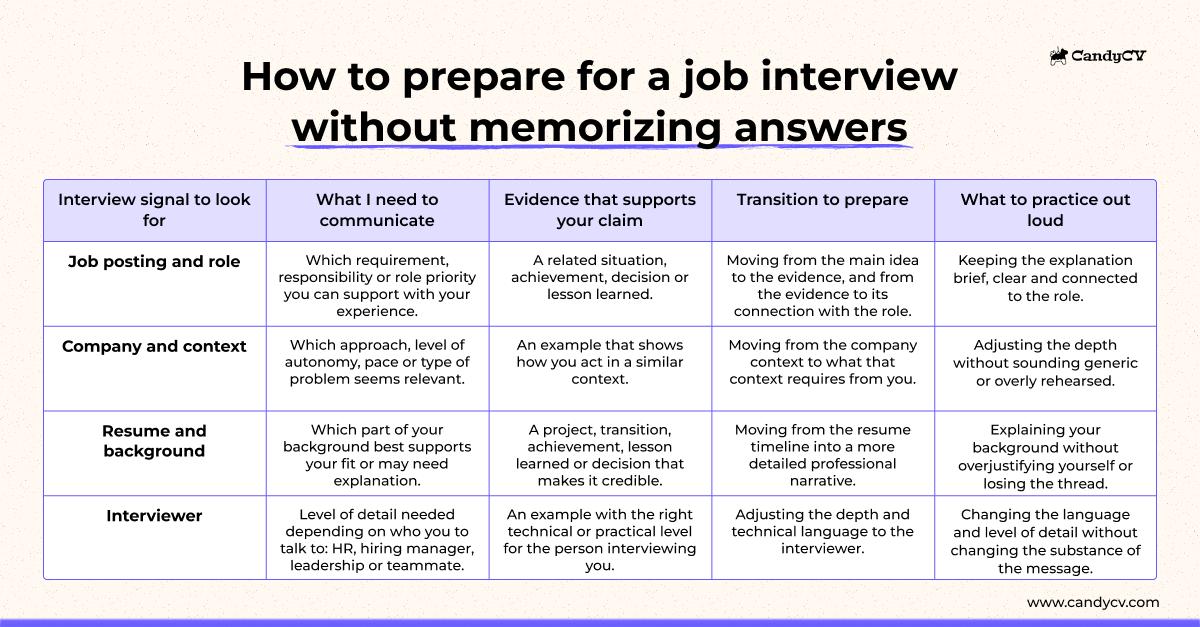
Job interview preparation matrix without memorizing answers
The matrix is meant to help you prepare for one interview realistically, not create an endless bank of answers. Use it with one job posting, one company and one interview in mind. If you try to fill it out for “any interview,” it may lose precision.
Start with the signals and what you need to demonstrate. Then move into messages, examples and out-loud practice. It is better to work on three or four important ideas than to collect ten vague answers.
| Interview signal | What I need to demonstrate | Evidence that supports it | Transition to prepare | What to practice out loud |
|---|---|---|---|---|
| Job posting and role | Which requirement, responsibility or role priority you can support with your experience. | A related situation, achievement, decision or lesson learned. | Moving from the main idea to the evidence, and from the evidence to its connection with the role. | Making the explanation brief, clear and connected to the role. |
| Company and context | Which approach, level of autonomy, pace or type of problem seems relevant. | An example that shows how you act in a similar context. | Moving from the company context to what that context requires from you. | Adjusting depth without sounding generic or overly rehearsed. |
| Resume and background | Which part of your background best supports your fit or may need explanation. | A project, transition, achievement, lesson or decision that makes it credible. | Moving from the resume timeline into a more detailed professional narrative: decisions, learning, growth and fit. | Explaining your background without overjustifying yourself or losing the thread. |
| Likely interviewer | What level of detail HR, a hiring manager, an executive or a future teammate may need. | An example with the right technical or practical level for the person interviewing you. | Moving from a general version into more detail, or from technical detail into a summary anyone can understand. | Changing language, detail and focus without changing the substance of the message. |
With this, you can decide whether your preparation needs another pass or whether you feel ready enough. If an answer is too long, generic, disorganized, defensive or has no example, memorizing it better will not fix the problem. Go back to the signal, clarify what you were trying to demonstrate and choose more useful evidence.
From here, the guide explains how to fill in the matrix and in what order: first the signals you need to read, then the evidence you can use, and finally how to practice and detect whether you need feedback.
What to look for before deciding what to say
Before preparing answers, you need to read the situation. A signal is a reasonable clue for deciding what the interviewer or hiring team may need to verify and which parts of your background you should have ready. There’s a reason for this: in hiring, the job itself is the starting point. The OPM describes job analysis as a way to understand what tasks are performed, what competencies are required, and how those elements connect. As a candidate, you do not have access to the company’s internal job analysis, but you can use the job posting, the role, the company, and the type of interviewer as clues to decide what you need to demonstrate in the interview.
Use this criterion:
Signal → what the interviewer or hiring team needs to verify → which part of my experience helps prove it.
If you jump straight into practicing answers, it is easy to end up with correct-sounding lines that are poorly connected to the role. If you first identify signals from the job posting, the role, the company, your background and the likely interviewer, you can prepare a more adaptable conversation: you know which topics probably matter, which doubts may come up and what material from your own experience you can use.
You cannot predict what every interviewer will think, but you can reduce improvisation: clarify which parts of the role seem critical, which parts of your experience can support them and which areas need especially clear explanation.
If your blocker is specific questions, use this guide on difficult interview questions: what they assess and how to answer them.
Job posting and role: what the hiring team needs to verify
The job posting gives you a lot of information about what the company is actually looking for: requirements, responsibilities, visible priorities, autonomy level, seniority, team context or the kind of problems that appear in the role.
A practical way to spot those signals is to underline:
- Requirements: which knowledge, tools, languages, experience or availability seem necessary.
- Responsibilities: what you will need to do repeatedly, not only what is “nice to have.”
- Role context: whether it looks like an execution, coordination, analysis, client-facing, team management, change, growth or ambiguous problem-solving role.
Then translate each signal into a preparation question: “What do I need to demonstrate here?” If the job posting emphasizes coordination across several teams, it may not be enough to say you work well with others; you need an example where the interviewer can see how you aligned criteria, handled information or resolved friction. If the role requires autonomy, prepare a situation where you made decisions with incomplete information or prioritized without constant instructions.
If you have not worked through the job posting yet and struggle to turn it into criteria, it may help to first review how to adapt your resume to a job posting. The principles are similar for resumes and interviews.
Resume and career background: what evidence you can prepare
Reviewing your resume before an interview is about deciding which parts of your background best support the fit you want to communicate.
Look for evidence in five places:
- Achievements or results you can explain without inflating them.
- Decisions you made and why they made sense.
- Projects that show how you work.
- Relevant changes, learning moments or transitions.
- Situations that connect with an important responsibility in the role.
The useful question is not “What have I done?” but “Which part of what I have done proves something this role needs to verify?” The same experience can support judgment, autonomy, learning, impact, collaboration or adaptability. What changes is the message you choose and the level of detail you decide to share. Later in the guide, you will see how to turn examples into evidence of fit.
It is also worth identifying areas that may raise questions for the interviewer or hiring team: career changes, short tenures, gaps, a jump in responsibility, lack of direct experience with a tool or a non-linear path. You do not need to become defensive or anticipate objections as if they were attacks, but you should prepare a clear explanation if that part may come up.
Company and interviewer: how to adjust depth and focus
You do not answer in exactly the same way to HR, a hiring manager, an executive or a future teammate. Not because you need to change your story, but because each interviewer may need a different level of detail about different things.
HR may focus more on your motivation, coherence, communication and general fit. A hiring manager usually needs more detail about how you work, how you solve problems and what technical or operational judgment you have. An executive may care more about impact, priorities, autonomy or business perspective. A future teammate may be assessing whether your way of collaborating fits the team’s day-to-day work.
When preparing, consider who will interview you so you can adjust depth and language.
Use that signal to complete the matrix: what this person needs to understand to assess your fit and which example will give enough proof without making the answer too long.
How to turn your examples into evidence of fit for a job interview
An example is not useful just because it is real. To work in an interview, it has to help demonstrate something relevant for that role. Useful evidence is specific, relevant, explainable and connected to what the hiring team needs.
Useful example = specific + relevant + explainable + connected to the role.
This is the difference between naming a skill and proving it. Saying “I am a problem solver” is a label. Explaining a situation where you prioritized, made a decision, handled a constraint and learned something shows more clearly what that skill looks like in the way you work.
The same experience can prove different things. The risk is trying to use it for everything and ending up with a confusing answer. Before taking an example into the interview, decide what job it needs to do:
- Demonstrate a skill.
- Explain a decision.
- Show a way of working.
- Justify a transition.
- Support a result.
- Clarify a possible concern about your profile.
You do not need to tell the whole case, only the part that works as proof. Sometimes that will be the result; other times, the judgment you used, the difficulty of the context, the decision you made or what you learned afterward.
You will know you have chosen strong examples if you can explain what happened, what you did, why it matters and how it connects with the role’s needs. If the example only helps you sound competent in the abstract, it is not evidence of fit yet and needs sharper focus.
Do not invent cases or inflate results to sound better. Beyond being unreliable, it often makes the interview harder: the more artificial an example is, the harder it is to explain naturally when the interviewer asks follow-up questions.
If you struggle to find raw material, this guide on turning your experience into concrete resume achievements can help. The difference is that, in an interview, you do not only need to write the achievement well; you need to be able to develop it with much more detail than you would in a resume.
And if what you need to work on in depth is how to prove a specific skill, the more useful guide is how to demonstrate skills with examples in an interview. There, the focus stops being the whole interview and becomes how to prove skills without staying at the label level.
How to prepare transitions and organize your ideas without learning a script
Once you have spotted signals and gathered possible examples, the next problem is often moving from one idea to another without losing the thread. That is why it is better to prepare transitions than complete answers.
A transition is a natural way to connect the pieces of your answer: the main idea, the example, the explanation, the connection with the role and the closing point. It is not an exact line to memorize. It is a bridge that helps you know what comes next.
The sequence can be:
Main idea → example → explanation → connection with the role → closing point.
You do not need to use it the same way every time. Treat it as a mental map so you do not start with too much context, get lost in details or end the answer without explaining why that experience matters.
You can prepare transitions by function:
| Function | What it helps with | Transition examples |
|---|---|---|
| Opening with the idea | Avoiding a long build-up, answering directly and then expanding. | “I would summarize it this way…”, “The most relevant part is…” |
| Moving into the example | Moving from claim to evidence. | “One example that shows this is…”, “For example…” |
| Explaining your role | Clarifying what you did and what your role was in the result. | “My responsibility there was…”, “The decision I made was…” |
| Connecting with the role | Keeping the example from standing alone and making the fit explicit for the interviewer. | “I think this would be useful here because…”, “I connect this with this role because…” |
| Closing | Making the main takeaway clear, returning to the confirmed idea and reinforcing it. | “The main thing I took from that experience was…”, “That is why I feel ready to…” |
This is more useful than memorizing a script because interviews do not always follow the order you expected. The interviewer may interrupt, ask for more detail, change topic or phrase the question differently. If you have only learned a closed answer, any change can throw you off. If you have prepared transitions, you can rebuild the answer without sounding artificial.
These are signs that you need to work on the transitions in an answer:
- You start with too much context and take too long to reach the main idea.
- You jump into the example without explaining what it proves.
- You explain what happened, but it is not clear what you personally did.
- You answer as if you were defending yourself, not explaining evidence.
- You finish the answer without connecting the example to the role.
- You need to remember an exact sentence to avoid getting lost.
- You cannot summarize the answer in one idea after saying it.
When one of these signs appears, do not try to memorize harder. Go back to the matrix and adjust one of three things: what you wanted to demonstrate, which example supports it or which transition you need to connect the pieces.
How to practice out loud to check whether the answer works
Practicing out loud is not about repeating an answer until it comes out exactly as written. It is about checking whether the idea is understandable, whether the example validates it and whether you can explain it naturally while adapting to the uncertainty of a conversation.
Thinking through an answer and saying it are not the same task. In your head, it may seem organized because you know all the context. When you say it, you notice interruptions, unnecessary loops, examples that are too long, weak connections and parts that sound less credible than you expected.
Also, interview pressure changes how you communicate. A CERIC summary of research on interview anxiety notes that self-reported anxiety is associated with lower interview ratings. In other words, feeling nervous does not mean you are not qualified for the role, but it can make it harder to show your qualifications clearly. Practicing out loud helps you spot that issue before the real conversation becomes your first test.
Do a first practice round without reading full notes. You can have the matrix from this guide or a list of evidence in front of you, but not a closed script. The goal is to observe how you answer when you have to build the explanation, not to check whether you remember a sentence.
If you plan to use ChatGPT at this stage, use it on top of that base: prepare your interview with ChatGPT, Claude or Gemini without generic answers, instead of asking for a final script to memorize.
Use these criteria as a reference:
| Criterion | What to check |
|---|---|
| Clarity | The main idea comes through early. |
| Structure | The answer has an opening, evidence, connection and closing point, even if it is not perfect. |
| Specificity | There is enough situational context, not only a general statement. |
| Credibility | What you say would hold up if the interviewer asked follow-up questions. |
| Precision | You do not exaggerate, overpromise or mix in distracting topics. |
| Confidence | You keep the thread without depending on exact lines. |
| Adaptation | You connect the answer with the role, the company or the interviewer, not with any interview in general. |
These criteria do not guarantee that the interviewer will like the answer or that the process will move forward. They help you detect whether your preparation is reducing improvisation, lack of structure and generic answers, which is what you can work on before the interview.
When to move from practicing alone to simulating a job interview
Practicing isolated answers helps you organize ideas. Simulating an interview makes sense when you need to test something closer to the real conversation: pressure, interruptions, follow-up questions, topic changes, adaptation to the interviewer or time management.
You do not need to simulate the full interview on day one. First, it is better to have minimally clear signals and evidence. If you simulate too early, you may confuse lack of content preparation with nerves or lack of practice.
A simulation is especially useful when:
- You already have examples, but you do not know whether you explain them clearly.
- You freeze when you get follow-up questions.
- Your answers work in writing, but when you say them you go in circles and notice you are failing one of the criteria.
- You are not sure how to adjust the level of detail for HR, a hiring manager, an executive or a future teammate.
- You want to build confidence in sustaining a conversation, not only answering a list of questions.
The practice happens by voice and ends with a report on patterns in clarity, structure, evidence and role connection, helping you decide which answer to work on again. This guide explains everything you need to know about practicing job interviews with AI.
The next limit appears when you practice, detect problems, but cannot identify the cause or the correction. At that point, self-evaluation may not be enough, and the useful question becomes feedback: what exactly do you need to improve before the real interview?
When you need feedback before the interview
You need feedback when practicing alone no longer helps you distinguish what is failing. If your answers sound generic, disorganized or not very credible, or if you do not know how to correct them, repeating them more times may make you more fluent, but not necessarily better.
For feedback to be useful, it has to be a specific observation about clarity, structure, specificity, credibility, precision, confidence and adaptation to the role. It should help you understand which part of the answer is not working and what you could change before the real interview.
That feedback should not stop at “you seemed nervous” or “you gesture too much.” The British Psychological Society’s Research Digest summarizes a study by Feiler and Powell on interview anxiety in which interviewers did not seem to penalize candidates only for small nervous behaviors, but for a broader impression of lower warmth or assertiveness. In other words, ask for specific feedback on whether your answer is easy to follow, whether you sound clear, whether your example holds up, and whether you maintain a credible conversation.
A practical way to decide is to review these signs:
| Sign | What may be happening | What to ask for in the feedback |
|---|---|---|
| You cannot summarize your answer in one idea. | You are mixing messages or giving too much context. | Ask what main idea they remember and where the thread gets lost. |
| You give correct answers that could apply to any interview. | The answer is not connected enough to the job posting, role or company. | Ask whether it is clear why that example matters for this specific interview. |
| You talk about skills without examples. | The answer stays at the label level. | Ask them to push you for a specific situation, decision or lesson that supports the skill. |
| Your answers get very long. | You are telling the whole chronology instead of selecting what matters. | Ask them to mark which parts are unnecessary and what the closing point should be. |
| You sound defensive about resume concerns. | You are justifying yourself more than explaining with judgment. | Ask them to help you reframe the answer around facts, learning and fit. |
| You do not know whether you communicate clarity or credibility. | Self-evaluation has reached its limit. | Ask them to assess whether the answer is understandable, sustainable and adapted to the interviewer. |
You do not need external feedback for every answer. It makes sense to ask for it when the interview is important, when part of your background is hard to explain, when you freeze during practice or when several answers seem prepared but not convincing.
It is also useful to distinguish feedback from diagnosis. If you are preparing for a specific interview, feedback should focus on how you communicate before that conversation. It may help to go deeper into job interview preparation mistakes that create false confidence.
There are tools on the market that can help you simulate a realistic conversation and give you a report with detected issues and improvements you can apply. No feedback guarantees that you will move to the next stage, but it can help you see problems you were not detecting while practicing alone. Check this guide on practicing job interviews with AI.
Basics to check before the interview
The basics matter, but they are conditions for the conversation, not the preparation method. Being on time, taking care of your online setup, listening well or preparing your own questions can improve the interview; but they do not compensate for answers without evidence, confusing messages or preparation based on memorized lines.
Before the interview, review the minimum:
- Logistics: confirm time, format, link, location, names of the people if you have them and any documents you need.
- Online interview: test camera, audio, connection, lighting, battery and a place where you can speak without predictable interruptions.
- Punctuality: leave real margin. Arriving rushed or joining at the last second adds unnecessary pressure.
- Attitude and listening: prepare your messages, but do not go in with a closed monologue. The interview is still a conversation.
- Body language: eye contact, listening, not interrupting, not hiding behind notes. Take care of the basics in any interaction.
- Your own questions: prepare two or three real questions about the role, the team, priorities or ways of working.
Your own questions should not be a ritual for “looking good.” They help you evaluate whether the role also fits you and show that you understood the conversation.
These basics help the interview flow, but they are not the core of preparation. Go back to the matrix before you finish: what you need to demonstrate, what evidence you have and how you will explain it.
What to do now to arrive better prepared for the interview
If you understand the method, the next step is to turn this preparation into concrete practice for your interview.
Start by filling out the matrix for the next interview you have: job posting, role, company, background and interviewer. Then review these steps depending on what you still need to work through:
1. Prepare the difficult questions that are predictable in your case.
Do not prepare a whole library of answers, but do prepare the questions that are likely to come up because of your background, the role or the process: transitions, gaps, weaknesses, lack of direct experience or reasons for changing jobs. Review eight common difficult job interview questions: what they assess and how to answer them.
2. Check whether your preparation is giving you a false sense of control and confidence.
Reading advice, writing answers or having examples in mind can create a sense of control, but it does not always mean you can explain yourself well under pressure. Particularly, focus on learning how to demonstrate your skills and prove your value in a job interview. Before you finish preparing, review common job interview mistakes.
3. Practice the conversation out loud and ask for feedback if you cannot evaluate yourself well.
Once you have signals, evidence and transitions, rehearse it as a conversation, not as a reading exercise. You can practice alone, with another person or with AI if you need to simulate pressure and receive feedback. If you want to use AI, start by understanding the criteria used to practice quality job interviews with AI tools.
The final check before the interview is:
I know what the interviewer or hiring team needs to see, I have my own evidence to prove it, I can explain it without a script and I have practiced it out loud.
That does not guarantee the outcome or remove nerves. But it does mean you are going in with stronger preparation than memorized answers: judgment, evidence and practice for a clear conversation about your fit.