Difficult job interview questions: what they may assess and how to answer

In job interviews, difficult questions are common. A question is difficult when it is very open-ended, has to be answered under pressure, leaves you with incomplete information or touches a sensitive topic: a weakness, a mistake, a conflict, why you left a job, fit for the role or salary. You cannot know for sure what each interviewer is thinking, but you can read what the question may be assessing and prepare an answer that is your own, credible and adaptable.
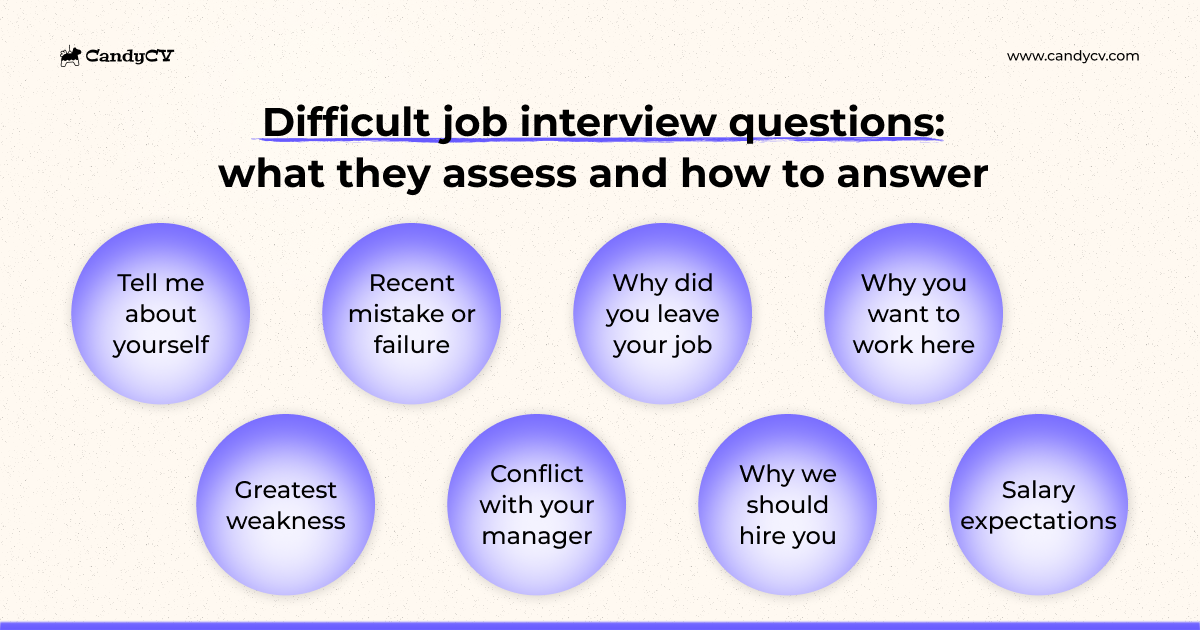
In this article, we will work through 8 common difficult job interview questions, shown in a matrix with this logic:
question → what it may assess → bad signal → evidence → flexible answer formula.
If you have not prepared the basics yet (the job posting, the requirements, your examples and the main message you want to communicate) it may be better to work on how to prepare for the interview without memorizing a script before practicing difficult questions. Here, we will apply that logic only to specific questions.
Matrix for answering difficult interview questions
Use this matrix as a quick diagnostic tool. Each question is explained in more depth later. It helps you understand what each question may assess and what evidence to prepare before you answer.
| Difficult question | What it may assess | Bad signal to avoid | Your evidence to prepare | Flexible answer formula |
|---|---|---|---|---|
| “Tell me about yourself” | Professional synthesis, focus and initial fit for the role. | Telling your life story, repeating your full resume or improvising without direction. | A career thread, 2-3 relevant experiences and a clear connection with the role. | “My background is in X, I’ve worked on Y, and I’m now interested in Z because it connects with this role.” |
| “What is your greatest weakness or area for improvement?” | Self-awareness, honesty and ability to improve. | Using a cliché, disguising a strength as a weakness or choosing a flaw that conflicts with the core of the job. | A real but manageable area, one improvement action and a reasonable boundary. | “I have noticed X; I am working on it through Y; in this role I would pay attention to Z.” |
| “Tell me about a mistake or failure at work” | Responsibility, learning and how you act when something goes wrong. | Blaming others, speaking badly about colleagues or managers, dramatizing or over-polishing the mistake. | Brief context, your share of responsibility, what you did next and a practical lesson. | “X happened, my part was Y, I did Z and I learned to prevent it this way.” |
| “Tell me about a conflict with a manager or coworker” | Relationship judgment, communication and how you handle disagreement. | Speaking badly about someone, sharing sensitive details or focusing too much on proving you were right. | A specific disagreement, your action, how you communicated and what boundary or lesson came out of it. | “There was a difference around X; I tried Y; the outcome or lesson was Z.” |
| “Why are you leaving your current job?” / “Why did you leave your last job?” | Motivation, maturity and coherence of your next step. | Sounding resentful, evasive or overly defensive. | An honest, brief reason framed toward the future and connected to what you want now. | “I’m looking for X because, in my previous role, Y; this role fits because Z.” |
| “Why should we hire you?” | Fit between role needs, your evidence and your possible contribution. | Saying you are “the best,” comparing yourself aggressively or listing skills without proof. | Two or three role requirements and real examples that support them. | “For this role, X and Y are important; I can contribute Z because I have done it in these contexts.” |
| “Why do you want to work here?” | Specific motivation, understanding of the role and realistic interest in the company. | Empty praise, answers copied from the company website or reasons that could apply to any employer. | Verified information about the role or company and a connection with your background. | “I am interested in X about this role/company, and I connect it with Y from my experience or way of working.” |
| “What are your salary expectations?” | Preparation, judgment and flexibility within a reasonable frame. | Improvising, giving a number without context or closing the conversation too early. | A reasoned range based on available information, role level and relevant conditions. | “Based on what I know about the role, I would be around X-Y, open to considering the full package and conditions.” |
8 difficult interview questions: what to say and what to avoid
Difficult questions do not all work with the same structure. Some ask for synthesis, others for self-awareness and others for an explanation of something that did not go well. In the following sections, you will find criteria for building a flexible version that sounds like you.
For each question, we will look at:
- What it may assess.
- What kind of answer can create a bad signal.
- What evidence you can use
- Where to set a reasonable limit.
For behavioral questions (mistakes, conflicts or past situations) a short structure like the STAR technique can help you organize situation, task, action and result, without turning every answer into a long story.
“Tell me about yourself”: summarize your profile without giving a biography
“Tell me about yourself” is not an invitation to tell your whole life story or to recite your resume from the beginning. It works better as a professional synthesis: who you are in terms of career path, which part of your experience matters for this role and why that connection makes sense at this moment.
The problem starts when the answer has no focus. If you begin with irrelevant personal details, list every job without hierarchy or end with generic phrases like “I’m hardworking and eager to learn,” the interviewer will struggle to see what matters in your answer.
That is why, before you answer, choose one thread to pull from. It can be a specialization, a coherent transition, a type of problem you have learned to solve or a combination of experience and motivation. You do not need to tell everything; you need to select what helps the interviewer understand your candidacy.
A flexible answer formula could be:
“My background has centered on [area or type of work]. In recent years, I have focused especially on [experiences relevant to the role], where I developed [judgment, skill or way of working]. I am interested in this position because it connects with [role need or professional direction].”
The limit is length and level of detail. If the question opens the interview, your goal is to orient the conversation.There will be time to go deeper into achievements, changes or specific decisions when more concrete questions come up.
“What is your greatest weakness?”: answer with self-awareness instead of clichés
The weakness question does not ask for a confession, and it definitely does not ask for a disguised strength. It may be exploring whether you have self-awareness, whether you can improve and whether you understand how your limits affect professional work. Along the same lines, Harvard Career Services treats negative questions as a way to observe how you handle difficult situations and how much self-awareness you have about your way of working.
The common mistake is trying to sound flawless. “I’m too much of a perfectionist” often creates the opposite signal: it sounds prepared to avoid saying anything real. It is also risky to choose a weakness that directly clashes with a core function of the role, because then the problem is not honesty but fit.
A stronger answer starts from a specific, manageable area that you know you can improve. It should have three pieces:
- What you have noticed.
- What you are doing to improve it.
- How you manage it so it does not hurt the work.
You do not need to dramatize it or justify yourself for two minutes. The more concise, the better. If the interviewer wants to go deeper, they will ask a more specific (and therefore easier) follow-up question.
Here is a useful counterexample:
“My biggest weakness is that I’m a perfectionist and I care too much.”
The problem is not only that it sounds overused. It also does not show learning, observable behavior or judgment about the role. A more useful version would follow this logic:
“I have had to work on [specific area], especially when [limited context]. To improve it, I now do [specific action]. In a role like this, I would pay attention to [boundary or practice] so it does not affect [role need].”
Before the interview, choose a weakness you can explain without sabotaging yourself. If the role requires constant client communication, making serious communication difficulty your main weakness is not a good idea. If the role requires high attention to detail, lack of attention to detail should not be the center of the answer. Honesty helps when it also comes with judgment.
“Tell me about a mistake or failure at work”: explain responsibility and learning
A question about a mistake or failure at work may be assessing responsibility, learning and decision-making when something does not go as expected.
The answer becomes weaker in three extremes: blaming others, dramatizing too much or choosing a “failure” so harmless that it says nothing. It is also better to avoid sensitive details about companies, teams or people. The answer should be honest, but not indiscreet.
To organize the answer, use a structure like this:
- Context: what happened, with only the detail needed to understand the situation.
- Your responsibility: what depended on you or what decision you could have made better.
- Action afterward: what you did to correct, repair or reduce the impact.
- Result or learning: what changed afterward and what you learned in practical terms.
- Application to the role: why that learning makes you more reliable in a similar situation.
A flexible formulation could be:
“In one situation, [brief context]. My share of responsibility was [decision, omission or judgment I could improve]. When I noticed it, I did [specific action] and learned [practical lesson]. Since then, to prevent it from happening again, I use [mechanism or habit].”
You do not need to choose the worst mistake of your career. Choose one that lets the interviewer see responsibility and applicable learning. If the story requires too much explanation to avoid sounding bad, it is probably not the best example for an interview.
“Tell me about a conflict with a manager or coworker”: show judgment without speaking badly about others
A conflict question is not about proving that you were right. It is about showing how you handle professional disagreement: what you did, how you communicated, what boundary you respected and what you learned for similar situations.
The answer starts to fail when it turns into a complaint: if you spend too much time explaining how difficult the other person was, share sensitive details or frame the conflict as a battle you won, the conversation shifts away from your judgment and toward your defensiveness.
Choose an example you can tell without exposing other people. It does not need to be a dramatic conflict; it can be a difference in priorities, a different way of organizing work, a disagreement about a decision or tension around deadlines. What matters is that your part is visible: how you listened, what you proposed, how you adjusted the approach or where you set a reasonable boundary.
A counterexample would be:
“My manager never listened to anyone, and in the end it was clear that I was right.”
The story may be true, but in an interview it gives little room to assess your communication. A more useful version would follow this logic:
“My manager and I had a difference around [specific topic]. I saw a risk around [professional risk], so I [your action: asked for context, proposed an alternative, aligned priorities, documented agreements]. The outcome was [result or lesson], and since then I pay attention to [criterion applicable to the role].”
The limit is not sharing more than necessary. Avoid names, personal judgments and internal details that do not add value. The answer should make it clear that you can disagree without damaging collaboration or losing sight of the work.
“Why are you leaving your current job?”: give context without overexplaining
This question does not require a full defense of your career path. A good answer gives an honest, brief reason oriented toward the next step: what is changing, what you are looking for now and why this opportunity fits that direction better.
The bad signal appears in two situations: speaking badly about the company, manager or previous team; and sounding so evasive that it looks like you are hiding something important. Give enough context and redirect the conversation toward the role you are applying for.
Prepare the answer through three decisions:
- Which reason you will name. Growth, type of project, scope of the role, learning, stability, industry change, conditions or fit with a professional stage.
- Which detail you will leave out. Not everything you lived through during a job exit belongs in an interview.
- Where you will take the answer. The question points to the past, but your closing should connect with the current role.
A flexible answer formula could be:
“In my previous role, I learned and contributed in [brief context]. I am now looking for [type of challenge, environment or responsibility] because I want to move my experience toward [professional direction]. This position interests me because [specific connection with the role].”
If the exit was difficult, you do not need to pretend everything was perfect. You can acknowledge it calmly: “that stage ended because of [general reason]” or “the project changed direction, and I am looking for a context where I can contribute more in [area].” The stopping point matters: if you keep justifying yourself after you have given enough context, the answer starts to sound defensive.
When the question points to gaps, frequent changes or overqualification, do not try to solve your whole trajectory inside this answer. Give context, show the professional thread and make clear why the current step makes sense. If there are several underlying concerns, prepare them separately.
“Why should we hire you?”: connect evidence with what the role needs
“Why should we hire you?” is not answered by saying you are the best option, because you cannot know what the other candidates are like. Answer by connecting the needs of the role with evidence from your experience and a possible contribution, without promising more than you can support.
The answer loses strength when it becomes so grandiose that it says nothing: “because I’m hardworking,” “because I learn quickly,” “because I’m the ideal candidate.” In an interview, a skill named without context often adds little; a skill connected to a real situation makes it easier to understand where that claim comes from.
A practical way to prepare the answer is to cross three elements:
- Role requirement: what seems important for this job.
- Your evidence: where you have done something similar, even if it was not identical.
- Likely contribution: how you could contribute in that specific context.
Selection interview guidance such as Acas guidance on interviewing job applicants recommends making decisions based on the job description and defined criteria for the candidate, not on loose impressions.
The answer can sound like this:
“Based on what we have discussed, [requirement 1] and [requirement 2] seem important in this role. I can contribute especially in [area] because I have worked on [specific evidence]. I am also interested in [aspect of the role], so I think I could contribute to [relevant but prudent contribution].”
The nuance is in the word “prudent.” You do not need to promise that you will transform the team. It is more credible to explain what you can contribute, what supports that claim and which part of the role you understand well.
“Why do you want to work here?”: show specific motivation without empty praise
This question is not asking you to recite the company’s “About us” page. It may be exploring whether you understand the role, whether your motivation is connected to the actual work and whether you have thought about why this opportunity fits your career path.
Interchangeable motivation weakens the answer: “I like your company,” “you’re a leader in the industry,” “I want to grow professionally.” Those phrases could apply to almost any interview with almost any employer. It is also risky to exaggerate your knowledge of the company if you have only read two headlines; motivation loses strength when it is not supported by something specific about the role, the team or the project.
Before answering, do a minimum amount of research and understand:
- What the company or team does.
- What responsibilities the role actually has, beyond the job posting.
- Which part connects with your experience, interests or way of working.
- What you can contribute in that context.
A flexible formula could be:
“I am interested in this role because of [specific aspect of the job], especially because it connects with [experience, judgment or professional interest]. I also noticed [specific element of the company or team], and I think I could contribute [contribution linked to the role].”
The difference from “why should we hire you?” is the focus. In “why should we hire you?” the center is the contribution you can make. In “why do you want to work here?” the center is specific motivation and its coherence with the role. The two answers can share evidence, but they should not sound the same.
The limit is not turning the answer into flattery or a declaration of love for the brand. Credible motivation is usually more sober and less exaggerated: it shows that you understood the company’s needs, that there is a connection with your way of working and your background, and that you are not using the same answer for every employer.
“What are your salary expectations?”: answer with a reasoned range without improvising
The salary expectations question works better if you arrive with a reasoned range, explain what it depends on and leave room to assess the full compensation package.
The main risk is improvising. Giving an exact number without context can leave you little flexibility; answering “whatever you offer” can sound unprepared; and opening a full negotiation too early can move the interview into territory that may not be ready yet. Here, the goal is not to close the final salary, but to show judgment, expectations and a willingness not to block the conversation.
Before the interview, prepare three pieces:
- A range, not just one number. If you have enough references, work with a reasonable range for the role level, your experience and the context you are applying in. It will help you negotiate.
- The reasoning behind the range. You do not need to explain every calculation, but you should know what supports it: responsibilities, experience level, location, market pay, conditions or scope of the role.
- Other parts of the compensation package. Variable pay, benefits, schedule, remote work, growth or stability can change how you evaluate the package. Do not close the conversation before understanding the context.
A solid formulation could be:
“Based on what I know about the role and the market, I would be around [range]. I would adjust that depending on responsibilities, the total package and conditions, but that is the framework I have in mind right now.”
If you do not have enough information, it is better to acknowledge the limit than to invent a number. In that case, turn the question back carefully:
“I would need to understand the scope of the role a bit better to refine it. Based on what I know right now, I would expect to be around [approximate range], but I can adjust that once I have more context.”
The limit of this section matters: this is not a salary negotiation guide. There is no universal range and no phrase that works for every industry, country or level. Preparation means not arriving blank, not giving a number you cannot defend and considering the full compensation package.
Questions that need caution: resume concerns and potentially discriminatory questions
If the question comes from an employment gap, a role change or a short tenure, you are not dealing with just another difficult question, but with a career-history concern: the interviewer may be trying to understand whether your path is coherent, whether there is a risk of mismatch or whether the role fits what you are looking for now.
The answer should not become a defense. The more you justify yourself, the more weight you give to the concern. You can organize the answer this way:
- Minimum context: what happened or why that apparent discontinuity exists.
- Professional thread: what you learned, what you kept or what decision explains the transition.
- Current fit: why this role makes sense now, without sounding like a temporary fix.
- Boundary: which detail you do not need to share if it does not help assess your fit for the role.
Personal or potentially discriminatory questions
Personal or potentially discriminatory questions should be handled with special care because they may touch personal data, health, age, family situation, origin, religion, disability or other circumstances that may not be relevant to assessing the job.
There are three possible moves, depending on the question and how comfortable you are answering it:
- Answer in a limited way. If the question has a practical connection to the job, you can answer only the relevant part. For example, availability to travel, work shifts or start on a certain date, without opening personal details that do not help.
- Redirect to the role. If the question enters personal territory, you can bring it back to the professional point: “If the concern is my availability for the schedule, I can confirm that…”.
- Ask for clarification. If you do not see the connection with the role, you can ask calmly: “Can you explain how this relates to the responsibilities of the position?”.
A prudent answer tries to separate personal information from your ability to do the job. You do not have to turn every sensitive situation into a confrontation, but you also do not have to share private details to prove commitment. If a question feels invasive or unrelated to the role, caution is part of a good answer.
Before you finish: check whether your answer is clear, yours and usable
A prepared answer is not a memorized answer. It is an answer you can say out loud, under pressure, with enough naturalness to support it with evidence and adapt it to the specific question without losing the thread.
Before you consider an answer to a difficult question ready, run it through this checklist:
- Can it be understood the first time someone hears it? If you need too many turns before getting to the point, you probably lack a central idea. Start with the short answer and add context only when it helps.
- Does it sound like your actual career path? An answer can be well written and still not sound like you. Replace phrases that feel too perfect with words you would use in a real professional conversation.
- Does it have evidence behind it? If you say you have learned, improved, handled a conflict or added value, there should be an experience, action or criterion behind that claim.
- Does it connect with the role? It is not enough to say something true. The answer should help the interviewer understand why that experience, lesson or motivation matters for this job.
- Does it avoid an unnecessary bad signal? Check whether you sound defensive, evasive, grandiose, resentful or too generic. Sometimes improving an answer means removing excess, not adding more arguments.
- Does it respect a reasonable boundary? For salary, job exits, career-history concerns or personal topics, check whether you are giving enough context without opening details that do not help assess your fit.
- Can you say it without reciting it? If it only works word for word, it is still fragile. Keep the order of ideas and practice variations so you can answer flexibly.
Do not prepare your answers only in a document. The useful test is a conversation. Say them out loud. Not doing this is one of the most common job interview mistakes.
Practice is should not turn into automatic or guaranteeing an outcome. It should help you detect problems before the interview: answers that are too long, examples that are unclear, endings that do not connect with the role or places where you get stuck. For that, practicing job interviews with AI can be useful.
If you have prepared your answers and want to see how they hold up under follow-up questions, you can practice them in a mock interview based on your resume and the job posting. You will answer out loud and use the report to identify where you ramble, which example needs more detail or which answer loses its connection to the role (not to get a perfect answer to memorize).
You do not need a perfect answer. You need an answer that is clear, your own, prudent and practiced enough to hold up in a conversation where you are being evaluated (and where you are evaluating them, too!).