What an ATS-friendly resume really means and why it matters

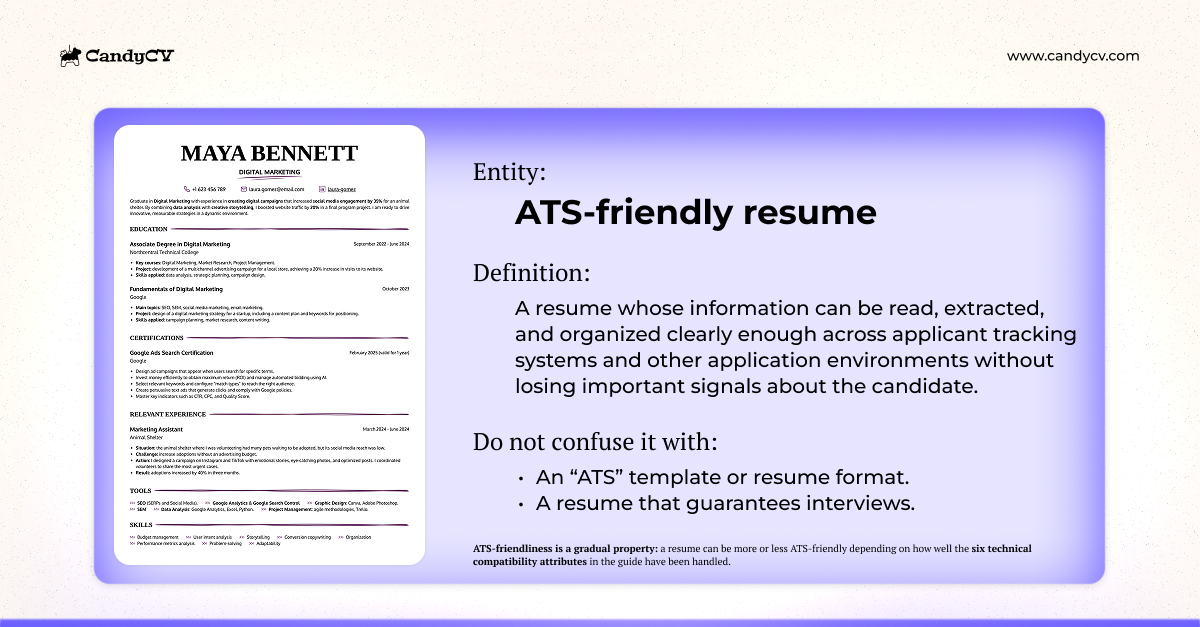
An ATS-friendly resume is a resume whose information can be read, extracted, and organized correctly by applicant tracking systems and other hiring-related technology, without losing important signals such as your target role, work experience, dates, education, or skills. That does not mean there is one special “ATS resume,” that using a certain template is enough, or that your resume will pass filters or get interviews on its own.
In this guide, you’ll understand:
- What the term ATS-friendly resume actually means
- Which attributes make a resume ATS-friendly
- The most common myths around resumes and ATS
- Why a resume can be technically ATS-friendly and still not be effective
- What to do next: test your resume, choose a safer template, or improve the content
What it means for a resume to be ATS-friendly
An ATS-friendly resume is one whose information can enter applicant tracking systems, job boards, and other hiring environments in a way that allows the content to be read, extracted, and reorganized clearly enough without losing important signals about your profile.
The key question is not how the resume looks at first glance, but how the resume behaves when another system tries to work with it. That is why ATS-friendliness should not be treated as a marketing label or a special type of resume. It is better understood as a functional property of the document:
The ability of a resume to preserve its information well when it stops being treated only as a document and starts being treated as a source of data.
This is not just about aesthetics, and it is not a simple pass/fail rule. A resume can be more or less ATS-friendly. It may preserve work experience and dates well but present skills poorly. It may keep a fairly clear structure while still depending too much on visual devices. It may work reasonably well in one application flow and create more friction in another. ATS-friendliness only makes sense as a concept because there are degrees to it, not just black and white.
It also helps to think beyond the corporate ATS alone. This matters in any environment where your resume is not just stored as a file, but its content comes into contact with hiring technology, job application forms, profiles, search tools, or process criteria.
The 6 attributes of an ATS-friendly resume
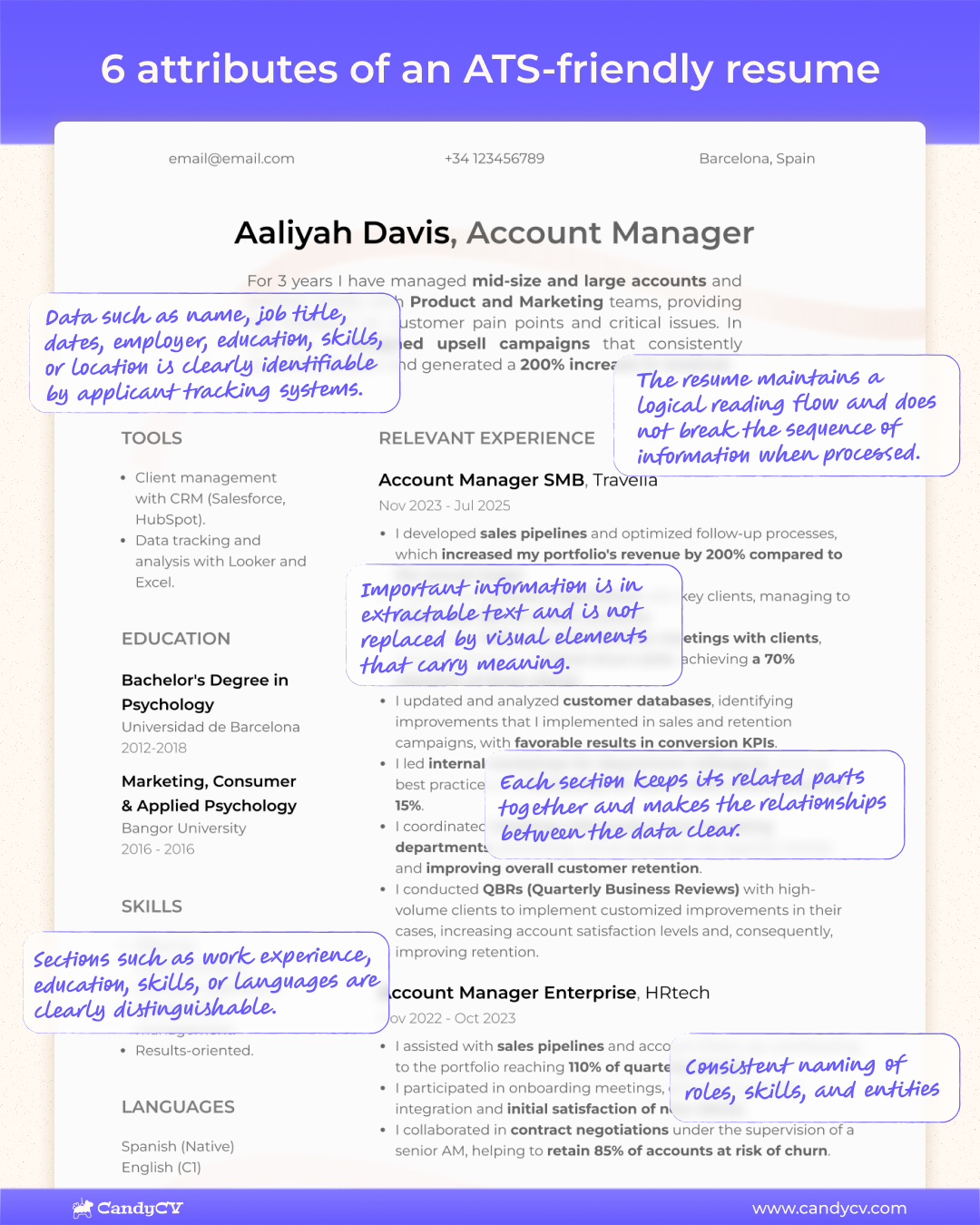
Technical compatibility does not depend on one magic rule. It depends on a set of attributes that help the information stay clear and usable when a system processes it. Here is a quick summary first, then a deeper explanation of each one.
| Attribute | What it means | Why it matters |
|---|---|---|
| Structural readability and reading order | The resume keeps a logical reading flow and does not scramble information when processed. | It helps prevent content from getting mixed up or placed in the wrong part of the system. |
| Extractable text content | Important information is written as usable text, not replaced by visual elements that carry meaning. | It allows systems to recover key signals without depending on visual layout alone. |
| Clear section recognition | Sections such as work experience, education, skills, or languages are easy to identify. | It helps the system understand what kind of information each block contains. |
| Integrity of key resume fields | Core data such as name, job title, dates, employers, education, skills, or location comes through clearly. | It reduces the risk of important profile signals arriving incomplete, mixed up, or degraded. |
| Internal coherence and semantic grouping | Each block keeps related pieces together and makes the relationships between them clear. | It helps the system understand which job title belongs to which employer, which dates match which role, and which tools belong to which context. |
| Consistent naming of roles, skills, and entities | Job titles, tools, skills, languages, or certifications are named consistently across the resume. | It strengthens the clarity of the signal instead of fragmenting it across inconsistent variants. |
The first attribute is structural readability and reading order. An ATS-friendly resume keeps a clear enough sequence when a system tries to read it as content, not just as visual layout. If the reading path depends too heavily on design or mixes information from blocks that should stay separate, compatibility drops even if the document looks fine to a person.
The second is extractable text content. Important information about your profile should exist as text that can be recovered and reused properly. When meaning depends too much on boxes, icons, bars, charts, or purely visual arrangement, the resume may still look polished, but it becomes weaker as a source of information.
The third is clear section recognition. It is not enough to include work experience, education, or skills. Those areas also need to be clearly distinguishable. A system should be able to identify what each block is without having to guess from an ambiguous layout, crowded content, or vague headings. English-language resume guidance also consistently favors standard section labels such as Work Experience, Education, and Skills, which reinforces this point.
The fourth is integrity of key resume fields. Some data carries a large part of the profile: your name, target role or specialization, employer names, dates, education, skills, languages, location, and other central signals in your career path. If those fields are inconsistent, hard to see, or difficult to connect to one another, the resume loses quality as a document that can be structured, even when the raw content is valid.
The fifth is internal coherence and semantic grouping. Compatibility does not depend only on whether the data exists, but also on how it is grouped. When your resume enters a system, each role should keep its parts together. Each section should have clear boundaries. The relationship between job title, employer, dates, responsibilities, and tools should be understandable without extra guesswork. That is what “semantic grouping” means here: checking whether the document keeps together the parts that an ATS or job portal needs to interpret as one unit.
The sixth is consistent naming of roles, skills, and entities. It also helps when important signals are named consistently across the resume. If the same tool appears in several different forms, if a job title changes wording with no clear reason, or if languages and certifications are presented inconsistently, the signal becomes less stable and easier to misread.
From there, two points matter:
- ATS-friendliness is not binary. A resume may handle structure and sections well but fall short on key fields or naming consistency. It makes more sense to think of it as a group of attributes solved better or worse, not as an absolute seal of approval.
- ATS-friendliness is useful, but not enough. A resume that reads and structures well is not automatically well tailored to a job posting, strong at communicating fit, or capable of generating interviews on its own. What it does do is make the information easier to use in search, filtering, review, or comparison.
What “ATS-friendly resume” does not mean: debunking myths
Calling a resume ATS-friendly does not mean it belongs to a special format category, that one specific template will solve everything, or that the resume will perform well in a hiring process by itself. The phrase describes one thing: that the information in the document can be read, extracted, and organized clearly enough. The problem is that people constantly mix that idea up with other ones.
Myth 1: There is one special ATS resume format
The first common confusion is the idea of the ATS template as the whole answer. A template may give you a safer structure, but it does not exhaust the idea of compatibility. A resume can use a template marketed as ATS-friendly and still be badly built in its key fields, internal organization, or naming of roles, skills, and tools. The opposite can also happen: a resume with a sober, well-structured layout may behave perfectly well without carrying any “ATS” label.
This is also where English search can be misleading. A lot of people look for “ATS-friendly resume template,” and there is nothing wrong with that as a practical starting point. But a template is a container, not proof that the information inside is strong or clearly structured.
The same applies to resume builders: before trusting an “ATS-friendly” claim, use this method to evaluate whether a resume tool is actually good.
Myth 2: If your resume is ATS-friendly, it should get interviews
This is the second big confusion: mixing up technical compatibility with effectiveness.
Those are two different properties:
- Technical compatibility
- Effectiveness, meaning whether the content actually communicates your fit, makes your value clear, and is well aligned with the role
You need both, but they do not solve the same problem.
A resume can be technically ATS-friendly and still be weak for the role it is targeting. It may have clear sections, clean dates, and visible skills, but still fail to highlight the most relevant experience, fail to reflect the job requirements, or use vague language that does not position the candidate clearly.
Myth 3: Optimizing for ATS means stuffing in keywords
No. Keywords matter, but ATS-friendliness is not about bloating your resume with terms from the job posting. A resume can repeat plenty of keywords and still be weak if the structure is confusing, if key fields are poorly handled, or if the information does not preserve clear relationships between its parts.
Myth 4: If a resume works for ATS, it automatically works for humans
There is overlap, because a good structure usually helps both systems and people. But the two are not identical. A resume can be technically sound and still be weak for human readers if it is dense, generic, or poor at communicating value. The reverse can also happen: a resume may look attractive and feel easy to skim for a person, but depend too heavily on layout, visuals, or design choices that make it more fragile when a system tries to interpret it.
Put differently, a resume can have strong substance but lose effectiveness if it is badly constructed or enters the system poorly. And it can also be technically compatible while still underperforming because the content is not well prioritized, tailored, or explained.
That is why it helps to separate three different questions:
- Does the resume enter the system well?
- Does it show fit for the role clearly?
- Does it persuade a human reviewer?
Those are related, but they are not the same thing.
Why ATS compatibility still matters even though systems vary
It still makes sense to talk about ATS compatibility even though not all systems work the same way, because the real question is not whether one universal rule exists for every platform. The real question is whether your resume preserves its information well when another environment tries to read and reuse it.
ATS platforms and job boards do not all have the same capabilities. They do not extract data with the same accuracy, and they do not use resume information in the same way. That is why absolute advice is usually weak. When someone reduces everything to “do this and you’ll pass any ATS,” they are usually flattening a reality that depends on the system, the application flow, and how the resume enters that process.
But variability does not make compatibility useless. It actually makes the concept more sensible when you define it properly. Talking about ATS-friendliness does not mean pretending all systems read the same way. It means recognizing that many application environments try to work with resume content as something more than a stored file. And the better that information holds up as text, structure, and related data, the less friction it usually creates.
The practical takeaway is not “anything goes,” and it is not “there is only one correct resume format.” The more useful conclusion is this:
Because systems and contexts vary, the safest approach is to avoid rigid rules and focus on the 6 properties that remain valuable across most of them: structural readability, extractable text content, clear section recognition, integrity of key resume fields, semantic grouping and consistent naming.
When technical compatibility matters less
There are situations where technical compatibility matters less as the main criterion. For example, when you send your resume directly to a person, when it is requested through an internal contact outside a formal application flow, or when the process depends much more on a portfolio, practical assessment, or prior conversation than on the resume as a data source.
Even then, structural clarity does not stop mattering. Whether there is an ATS in the loop or not, it still helps when your resume organizes information well, makes key fields visible, and does not force someone to reconstruct basic relationships between work experience, dates, tools, and education.
In other words, there are contexts where technical compatibility matters less, but a confusing resume almost never becomes a good idea.
| Context | How much technical compatibility matters | Why |
|---|---|---|
| Applying through a job board or careers page with a form | High | The resume enters an environment that may try to read, combine, or reuse the content. |
| Formal hiring process using a company ATS | High | Resume data may be used in review, search, filtering, or comparison. |
| Sending your resume directly to a recruiter or hiring manager outside a formal flow | Medium | Automatic structuring may matter less, but document clarity still matters. |
| Internal referral or informal contact | Medium-low | Access to the process may depend less on the resume, though the document still affects evaluation. |
| Portfolio-heavy or skills-assessment-heavy processes | Low-medium | The resume may carry less weight, but it still helps when it is well organized. |
What to do next
The most useful next step after this article is to check whether your resume really has this property of ATS-friendliness. And if you are rebuilding it from scratch, start with a format that gives you a safer structure.
- If you want to test whether your resume is readable and well structured, go to: how to test whether your resume is ATS-friendly (5-step method).
- If you would rather start from a safer format, go to: 3 examples of ATS-resume templates that work and which one to choose.
-
And if you are rebuilding your resume from scratch, it also helps to compare the best resume builders instead of choosing a tool only because it promises ATS compatibility.