Common job interview mistakes: what to avoid and what to fix first

Common job interview mistakes go beyond being late or choosing the wrong outfit. The mistakes that can weaken your fit signal the most range from unclear answers, weak evidence for your skills, and stories that do not sound plausible, to never having practiced the conversation out loud.
Here, a job interview mistake means a behavior, omission, or way of answering that can make your fit look weaker than it really is.
Not every mistake carries the same weight. In this article, we group them into three levels:
- Critical mistakes, when they weaken the foundation of your fit signal.
- Important mistakes, when they make the conversation lose focus or connection with the role.
- Contextual basics, when they create avoidable noise in the conversation.
Fixing these mistakes can improve how you come across as a candidate, but it does not guarantee that you will move forward in the process and it does not replace full interview preparation. If reviewing these common mistakes shows that you still need a stronger way to prepare, the next step is to prepare for a job interview without memorizing answers.
Common job interview mistakes checklist: what to review before your next interview, in priority order
Use this checklist to mark what may be happening to you, then go to the relevant section of the article to understand what to adjust. The order matters: start with the mistakes that can weaken the signal you are sending the most.
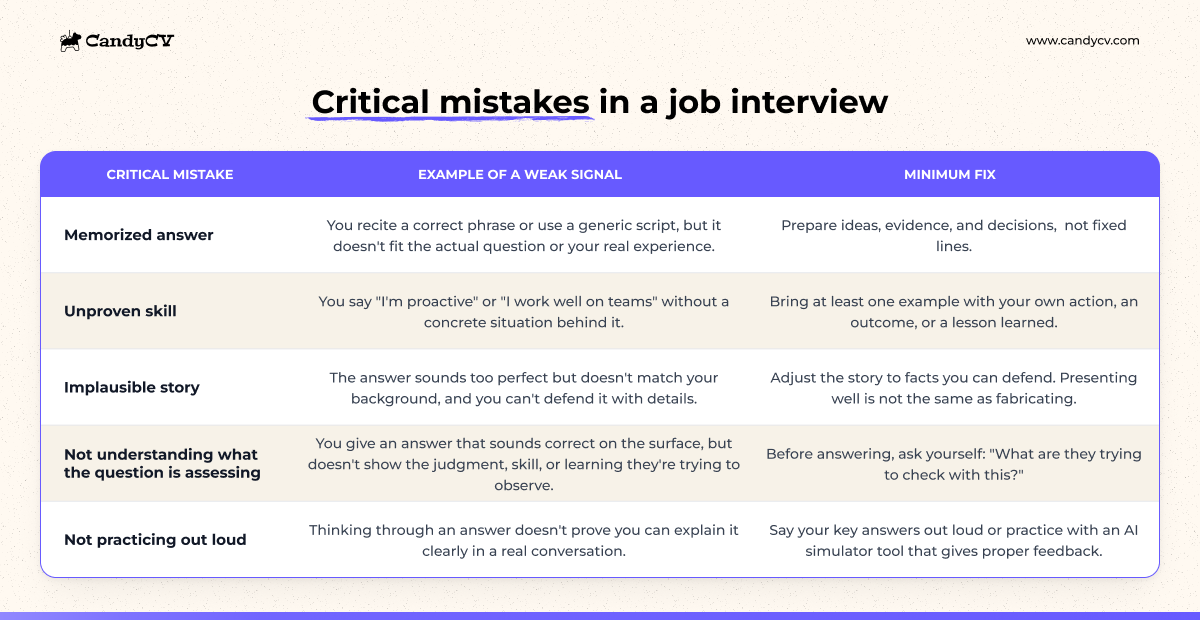
1. Critical mistakes
| What you do | Why it matters | Minimum fix / where to go deeper |
|---|---|---|
| You memorize answers or use generic scripts. | It may make you feel safer, but it makes it harder to adapt your answer to the actual question and your real experience. | Prepare ideas, evidence and decisions, not fixed lines. If the problem is uncomfortable questions, work on difficult interview questions: what they assess and how to answer them. |
| You claim skills without examples or evidence. | Saying “I’m proactive” or “I work well on teams” does not show fit if there is no concrete situation behind it. | Bring at least one example with your own action, an outcome or a lesson learned. To work through the full method, go deeper into demonstrating skills with evidence in an interview. |
| You invent, exaggerate or build stories that are not plausible. | An answer that sounds too perfect can become less credible if it does not match your background or you cannot defend it with details. | Adjust the story to facts you can defend. Presenting an experience well is not the same as fabricating it. |
| You answer without understanding what the question is assessing. | You may give an answer that sounds correct on the surface, but does not show the judgment, skill or learning the question is trying to observe. | Before answering, ask yourself: “What are they trying to check with this?” |
| You do not practice how you will answer out loud. | Thinking through an answer does not prove that you can explain it clearly in a real conversation. | Say your most important answers out loud, record yourself, ask for feedback or practice with an AI interview simulation that gives useful feedback. |
2. Important mistakes
| What you do | Why it matters | Minimum fix / where to go deeper |
|---|---|---|
| You do not adapt your examples to the role or the company. | A good example loses strength if it does not connect with what that role needs. | Reread the job posting and adapt one example to a specific need of the role. If you do not know how to do that, use the general method for preparing for job interviews. |
| You talk about negative experiences without reframing them. | It can sound evasive, resentful or unprofessional if you only shift responsibility to other people. | Explain the fact, context, learning and current approach, without polishing the story into something false or turning it into a complaint. |
| You do not prepare your own questions with intention. | The interview also helps you evaluate the role, team, expectations and process; asking nothing can make you lose important information. | Prepare 2 or 3 useful questions. Asking about salary, working conditions or remote work is not automatically taboo; that information is often necessary for you to decide whether the opportunity is actually right for you. |
| You use AI to fabricate answers that do not come from your experience. | It can produce answers that look correct but sound generic, unnatural or hard to defend if the interviewer asks follow-up questions. | Use AI to organize real evidence or get feedback, not to invent answers. Go deeper into practicing job interviews with AI: when it helps, when it does not and how to use it well. |
| You ramble, answer too briefly or do not answer the question asked. | The other person may not understand what you are trying to show, or may not get enough evidence to assess your fit. | Use a minimum structure: main idea, concrete evidence and a closing line connected to the question. |
3. Contextual basics
| What you do | Why it matters | Minimum fix / where to go deeper |
|---|---|---|
| You are late or improvise the logistics. | It can create a signal of low planning or low interest before the conversation even begins. | Confirm the time, format, link if it is online, address if it is in person, and your arrival buffer. If something unexpected happens, let them know as soon as you can. |
| You do not silence your phone, creating possible interruptions. | It breaks focus and can suggest that you are not fully present in the conversation. | Silence notifications, close unnecessary tabs and prepare a reasonably stable environment if the interview is online. |
| You do not adapt your presence to the context. | Appearance does not prove fit by itself, but it can create noise if it is very disconnected from the professional setting. | Choose a polished, context-appropriate appearance or setup, without obsessing over universal rules. |
| You interrupt, do not listen or answer before you understand. | It can make your answers feel less aligned, even if you prepared good content. | Let the question finish, ask for clarification if needed and answer what was asked, not what you memorized. |
| You end the interview without clarifying next steps. | You may lose useful information about timing, stages or expectations in the process. | If it is not clear, ask about the next step and the approximate timeline. |
The checklist tells you where to look first. From here, the article develops each group of mistakes and gives you practical ways to correct or avoid them.
Why these mistakes can weaken your fit signal in an interview
An interview does not evaluate only what you have done. It also evaluates how you explain it in a specific conversation. That is why some mistakes matter not just because they “look bad,” but because they can change the signal the other person receives: a solid experience can seem less clear, less credible or less connected to the role.
What often happens is this: you do something that makes you feel safe, such as memorizing an answer, but the signal received can be the opposite. Instead of showing judgment, experience or learning, the answer sounds prepared on the surface and weak when a follow-up question appears and the interviewer tries to go deeper.
The evidence reviewed supports this as a mechanism. For example, the meta-analysis by Barrick, Shaffer and DeGrassi on appearance, self-presentation and verbal/nonverbal behavior and the meta-analysis by Peck and Levashina on impression management suggest that how information is presented can be related to interview ratings.
That is why this guide prioritizes what can make your fit harder to understand first, what makes the conversation lose focus second, and contextual issues last. The goal is not to perform better. It is to make what you can already support with your experience more defensible.
Critical job interview mistakes: when you seem prepared but do not convince
Critical mistakes are the ones that make an interview seem prepared, but not necessarily convincing. They often show up when you bring rehearsed answers, unsupported claims or stories that sound too perfect, but you cannot defend them with depth and flexibility in a conversation.
You do not need to memorize a method or manufacture an ideal version of yourself. You need to detect the weak signal, replace it with concrete evidence and practice the interview.
Memorizing answers or using generic scripts
Memorizing can calm you down, but it can also make the answer more fragile. If the question changes slightly, if you are asked for a more specific example or if there is a follow-up question, the script may stop working and the conversation may sound less natural than you expected.
The typical symptom is that you have prepared sentences, but you cannot move them. You answer something that seems correct, but it does not quite connect with the question you were asked, your experience or the role.
A more useful way to prepare is to bring ideas, not sentences. For example, instead of learning a closed answer about a strength, prepare one concrete piece of evidence, what you did, what decision you made and what you learned. The same evidence can adapt to several questions without turning into a recital.
Claiming skills without examples or evidence
Saying “I’m proactive,” “I work well on teams” or “I learn quickly” does not prove fit by itself. It may be true, but in an interview the claim needs at least some proof so the other person can assess it.
The weak signal appears when the skill stays as a label. The interviewer hears a quality, but does not see a situation, your own action, a decision, an outcome or a lesson that supports it. At that point, the answer can sound interchangeable with any other candidate’s answer.
Usually, a skill starts to become defensible when you can connect it to a concrete example, explain what you did and close with an outcome, a change or a lesson learned.
The minimum fix before the interview is to choose 3 skills relevant to the role and prepare a short piece of evidence for each one. If you cannot find any example, maybe that skill is not the best one to defend in that interview, or it needs to be worded more precisely.
Inventing, exaggerating or building stories that do not sound plausible
You do not need to invent anything to tell an experience well. You can organize a story, select what matters and explain your role better without turning it into an inflated version that you probably cannot sustain if they ask for details.
The risk of inventing or exaggerating is not only ethical, and it cannot be reduced to “they will always catch you.” Studies on faking in interviews suggest that an inflated story can improve initial impressions or scores in a simulation, but that advantage depends on whether the story sounds credible. In the study by Roth, Klehe and Willhardt on deceptive impression management, deceptive tactics directly increased ratings, but also reduced the plausibility of and confidence in the answers. And the work by Buehl, Melchers, Macan and Kühnel on faking in interviews shows that faking can raise scores in a simulation, not that it is a solid strategy for staying credible as a candidate when follow-up questions, resume details or later stages come up.
To avoid this, adjust the story to facts you can defend. Replace “I led the entire project” with a precise explanation of your part in it. Replace “I solved the conflict” with what you did, what was under your control and what you learned. Plausible does not mean perfect; it means coherent with your experience.
If you struggle to find a strong version without exaggerating, you probably do not need to invent more. You need to select the evidence you already have more carefully. An honest answer can be stronger when it explains judgment, responsibility and learning without promising more than actually happened.
Not understanding what the question is assessing
Many answers fail because they answer the question superficially, but not the criterion behind it. In an interview, “Tell me about a conflict” is usually not only asking for an anecdote. It may be trying to observe how you interpret a situation, how you take responsibility, how you make decisions and what you learn.
The symptom is answering quickly with the first story that comes to mind. The answer may be true, but it may not show the skill, priority or reasoning the question is trying to check.
This idea connects with research on the ability to identify evaluation criteria: Melchers and colleagues observed in a simulated interview that people who identified the assessed dimensions better received better evaluations. More recent evidence on situational interviews also suggests that knowing the criterion helps more in some questions than in others, as shown by Latham and colleagues. So the point here is not to guess a perfect answer, but to answer the criterion that is probably at stake.
The fix is not to prepare a perfect answer for every possible question. It is to learn how to translate the question into an evaluation criterion and answer from there. If this is your main blocker, go to the guide on difficult interview questions. That is where we go deeper into what common open-ended questions may assess and how to approach them without giving you a bank of closed answers.
Not practicing how you will answer out loud
Thinking through an answer does not prove that you can say it well. Writing it down does not prove it either. The interview happens out loud, with interruptions, limited time, nerves and follow-up questions; that is why an answer that works in your head can sound long, flat or confusing when you say it.
The mistake is not being nervous. Feeling nervous can be part of an interview and should not be treated as a personal failure. What can hurt you is never checking how your ideas sound when you have to explain them in a conversation.
Practicing the interview out loud can help you communicate better, as shown in the study by Latham and Budworth, where they found better ratings after training in a small sample of IT professionals.
Practice does not guarantee the outcome, but it can help you detect sentences that are too long, examples without a closing point, jumps in logic or answers that depend too much on reading a script.
The fix is to choose your most important answers, say them out loud and review them with a concrete signal: is the main idea clear, is there evidence, am I answering what was asked, can I close without rambling? If you can, record yourself or ask for feedback from someone who will not mentally complete the answer for you.
If you need follow-up questions, moderate pressure or more structured feedback, CandyCV's mock interview simulator lets you answer out loud using your resume and a job posting, then review a report on patterns across your answers. That feedback does not predict the hiring outcome, but it can help you identify what to fix before the real interview.
Important mistakes that make the conversation lose focus or connection with the role
These mistakes do not always carry much weight on their own, but they can make good preparation lose strength. They often show up when you already have examples, questions or ideas prepared, but you do not connect them well with the role, the moment in the conversation or your actual experience.
Not adapting your examples to the role or company
A good example can fall short if it does not show how it relates to what the role needs. The interview is not only trying to check whether you have done valuable things, but whether those things help the hiring team understand how you could fit in that specific context.
A useful check is: “Does this example respond to a need in the role?” If the job posting emphasizes coordination, an impressive individual achievement may not be enough. If the role requires autonomy, it is not ideal to choose only examples where someone else made all the decisions. If the context is changing quickly, evidence of adaptation may matter more than a story of perfect execution.
The fix before the interview is to review the job posting and mark the needs that are likely to matter most: responsibilities, tools, pace, relationship with other teams, level of autonomy or problems the hired person will need to solve. Then adjust one or two examples so the connection is explicit, without forcing it or inventing fit where there is none.
Talking about negative experiences without reframing them
The point is not to hide the negative or pretend everything was a learning experience. A difficult departure, a conflict, a bad project or a hard work relationship can be explained professionally. The problem appears when the answer becomes a vent, a defense or an evasion.
If you only blame other people, it can sound like a lack of self-awareness. If you polish it too much, it can sound less credible. If you avoid all detail, you may leave unexplained what you learned or how you would act now in a similar situation.
A useful pattern is: fact, context, learning and current approach. For example:
- Fact: what happened, without unnecessary detail.
- Context: what conditions influenced the situation.
- Learning: what you understood or what you would do differently.
- Current approach: how you handle a similar situation now.
There is a difference between saying “my previous manager was impossible” and explaining: “the context changed quickly, priorities were unclear and I waited too long to ask for alignment; now I try to clarify expectations before the problem builds up.” It is not an ideal answer, and it does not force you to take blame that is not yours, but it shows more judgment than a plain complaint.
The fix is to prepare a brief version of any predictable negative experience. If the topic appears as an uncomfortable question (conflicts, mistakes, layoffs, departures or changes in direction) it is worth going deeper into difficult interview questions without turning every answer into a defensive story.
Not preparing questions for the interviewer with intention
Not preparing your own questions can make you lose important information. The interview also helps you evaluate the role, the team, expectations and the process; it is not only a one-way exam.
The mistake is usually arriving at the end with no questions, repeating questions that have already been answered, or asking just to ask. A good question should help you make a better decision or understand something relevant about the context.
It is also worth challenging a rule that is repeated too often: asking about salary, working conditions, remote work or time off is not universally taboo. It depends on timing, the information you already have, the stage of the process and how you ask. Wanting to understand the conditions is normal; what can weaken the question is bringing it up without context, in a disconnected way or as if it were the only thing that matters to you.
One fix is to prepare 2 or 3 questions with different intentions: one about role expectations, one about the team or ways of working, and one about the process or next steps if that has not been made clear. If you need to discuss conditions, think first about what information is missing and what the reasonable moment is to address it.
Using AI to fabricate answers that do not come from your experience
AI can help you organize ideas, detect gaps or practice with feedback. The problem appears when you use it to fabricate closed answers that do not come from your experience and then try to memorize them.
That use can produce sentences that look correct on the surface but sound generic. It can also create stories that are too polished, unnatural or hard to defend if the interviewer asks for details: what you did, why you made that decision, what went wrong or what you learned.
The responsible limit is to use AI to work on real material, not to replace it. If you give it a concrete experience, it can help you organize it, make it clearer or detect missing evidence. If you ask for a closed answer without providing context, it will probably return something anyone could say.
One fix is to change the type of request. Instead of asking “write me an answer about leadership,” work with one of your own situations and ask for feedback: what is unclear, what evidence is missing, where it sounds generic or what follow-up question could appear. That keeps the answer anchored in defensible facts.
If you want to use AI to practice, the next step is not collecting more scripts, but practicing interviews with AI and useful feedback. If the tool you are using is ChatGPT, work from a guide to prepare for an interview with ChatGPT, Claude or Gemini without generic answers before asking it for a final answer to memorize.
Rambling, answering too briefly or not answering what was asked
A useful answer does not have to be long, but it does need to be enough. If you ramble, the other person may lose the main idea. If you answer too briefly, you may not give enough evidence to assess your fit. And if you answer a different question, even good content can leave a disorganized signal.
- The symptom of rambling is starting with one idea, jumping to another and ending without closing the first one.
- The symptom of answering too briefly is responding with a label (“yes, I have experience,” “I adapted well,” “I handled it”) without explaining the situation, action or learning.
- The symptom of not answering the question is using a story you prepared even though the question was asking for a different criterion.
A minimum structure is usually enough: main idea, concrete evidence and a closing line connected to the question.
With these adjustments, the critical and important mistakes are covered. What remains are contextual basics: punctuality, phone, presence, listening and closing. They are worth taking care of, but they should not become the center of the interview.
Punctuality, phone and presence: contextual basics worth taking care of
Punctuality, phone, presence, listening and closing matter, but as context. They do not replace an answer with evidence, and they do not prove by themselves that you fit the role; they reduce noise so the conversation can focus on what matters.
It is better to treat them as professional basics, not as a list of perfect gestures. A person can be nervous, have a different communication style or need accessibility accommodations without that being a “mistake.” The risk appears when something avoidable interrupts the conversation, suggests low planning or makes it harder for the other person to understand your answer.
The contextual basics worth reviewing are these:
- Logistics and punctuality. Confirm the time, format, link, address, contact person and arrival buffer. Arriving with reasonable time reduces surprises; arriving excessively early does not always help either. If a problem comes up, let them know as soon as possible and give concrete information.
- Phone and notifications. In an in-person interview, your phone should be silenced and out of sight. In an online interview, close notifications, unnecessary browser tabs and anything that could interrupt or distract you.
- Presence adapted to context. Clothing or environment does not prove your ability, but it can create noise if it is very disconnected from the industry, role or format. The goal is not to look like someone else, but to show care and coherence with the situation.
- Listening and interruptions. Letting the question finish, asking for clarification if something is unclear and answering what you were asked is usually more useful than trying to force in a prepared answer. Listening also helps you adapt examples and avoid repeating information that has already been covered.
- Closing and next steps. If it has not been explained, ask about the next stages or approximate timing. A follow-up message can make sense if it thanks them for something specific or adds useful information, but it should not become an automatic gesture to “score points.”
Be careful with advice about body language, too. Nonverbal signals can influence the impression the other person receives: the meta-analysis by Martín-Raugh and colleagues found associations between some nonverbal cues and interview ratings. But that evidence should be read carefully, because it may also capture evaluation biases. Also, studies such as the one by Bangerter and Tescari suggest that global impressions may matter more than isolated micro-gestures. Turning this into rigid rules (e.g. “always look this way,” “smile like this,” “sit like this”) is usually not helpful. Think in terms of clarity, attention and overall coherence, not a perfect performance.
What to fix today if you have little time before the interview
If you have little time, do not try to fix everything. Choose one or two mistakes in priority order and apply a minimum fix that you can test before the interview. It is better to arrive with one well-defended piece of evidence and one answer practiced out loud than with twenty tips you have read and none you have tested.
Start with what can weaken your fit signal the most: an important skill with no example, a difficult answer you are memorizing, a story that sounds too inflated or an explanation you have never said out loud. Fix that first. Then review one contextual basic so you do not create unnecessary noise: time, link, phone, environment or next steps.
The useful question is not “How do I avoid every mistake?” but “What weak signal can I reduce before I enter the interview?” Sometimes that means adding concrete evidence. Other times, shortening an answer that rambles. Other times, stopping the script-learning and practicing how to explain an experience in your own words.
This does not change every factor in the process and it does not guarantee the outcome. It can help you arrive with less false confidence and a more defensible way to explain your fit.