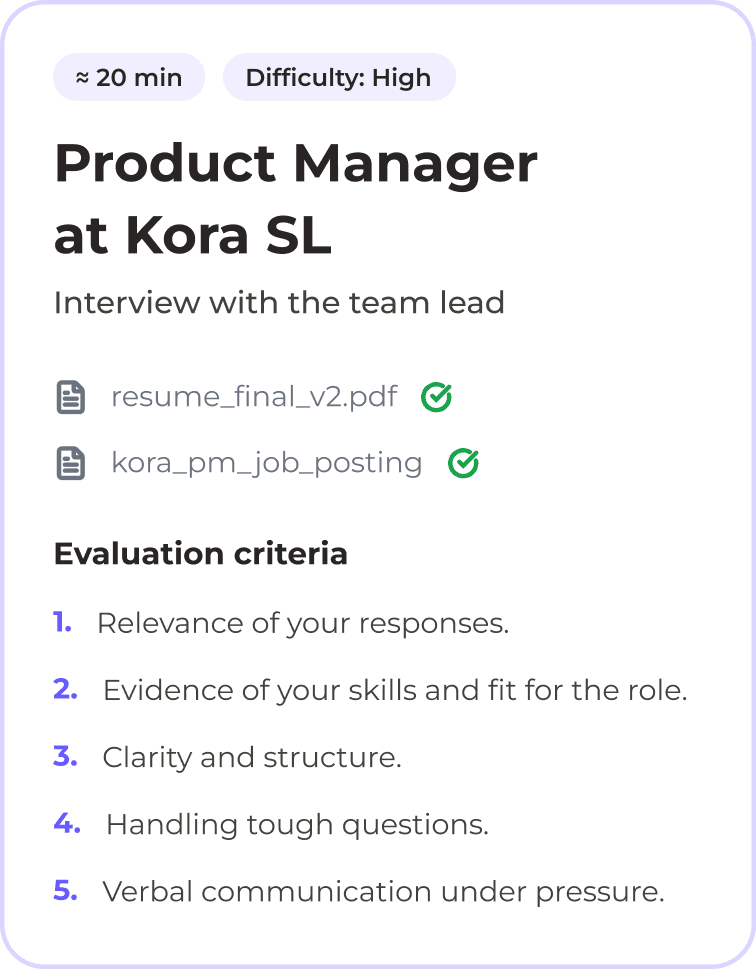
A 20-minute AI mock interview
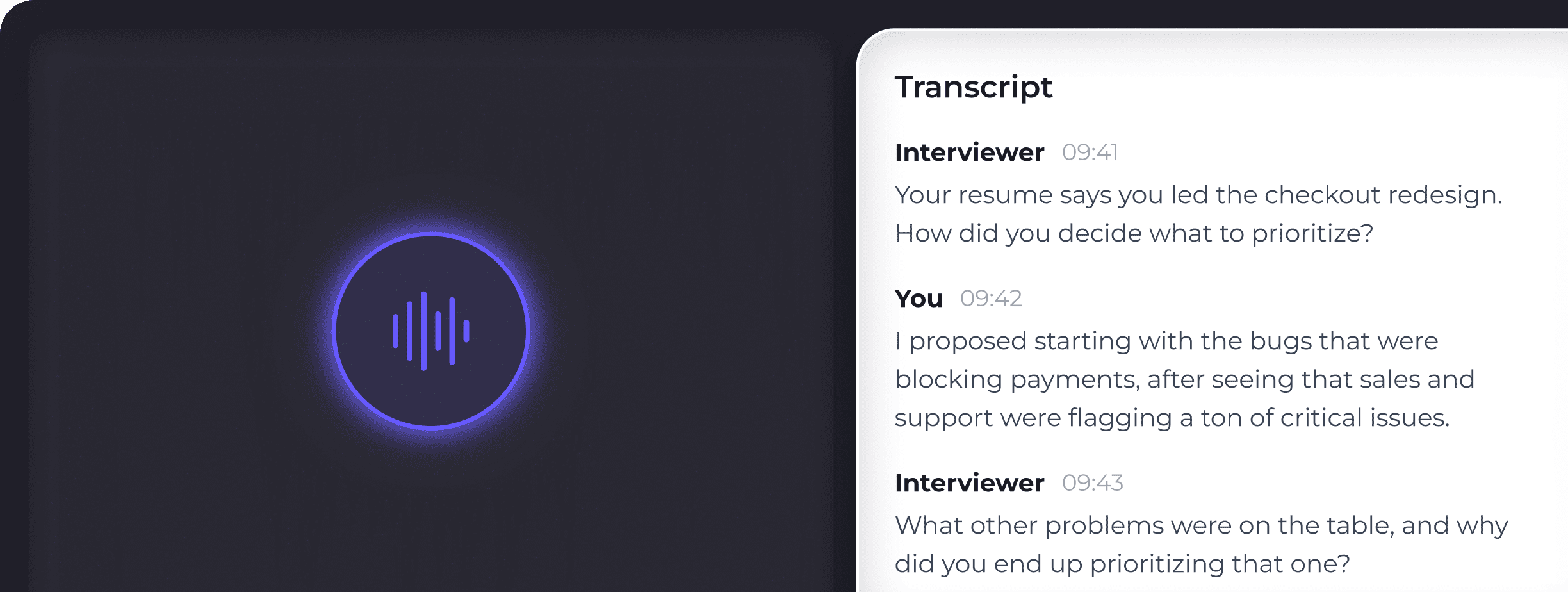
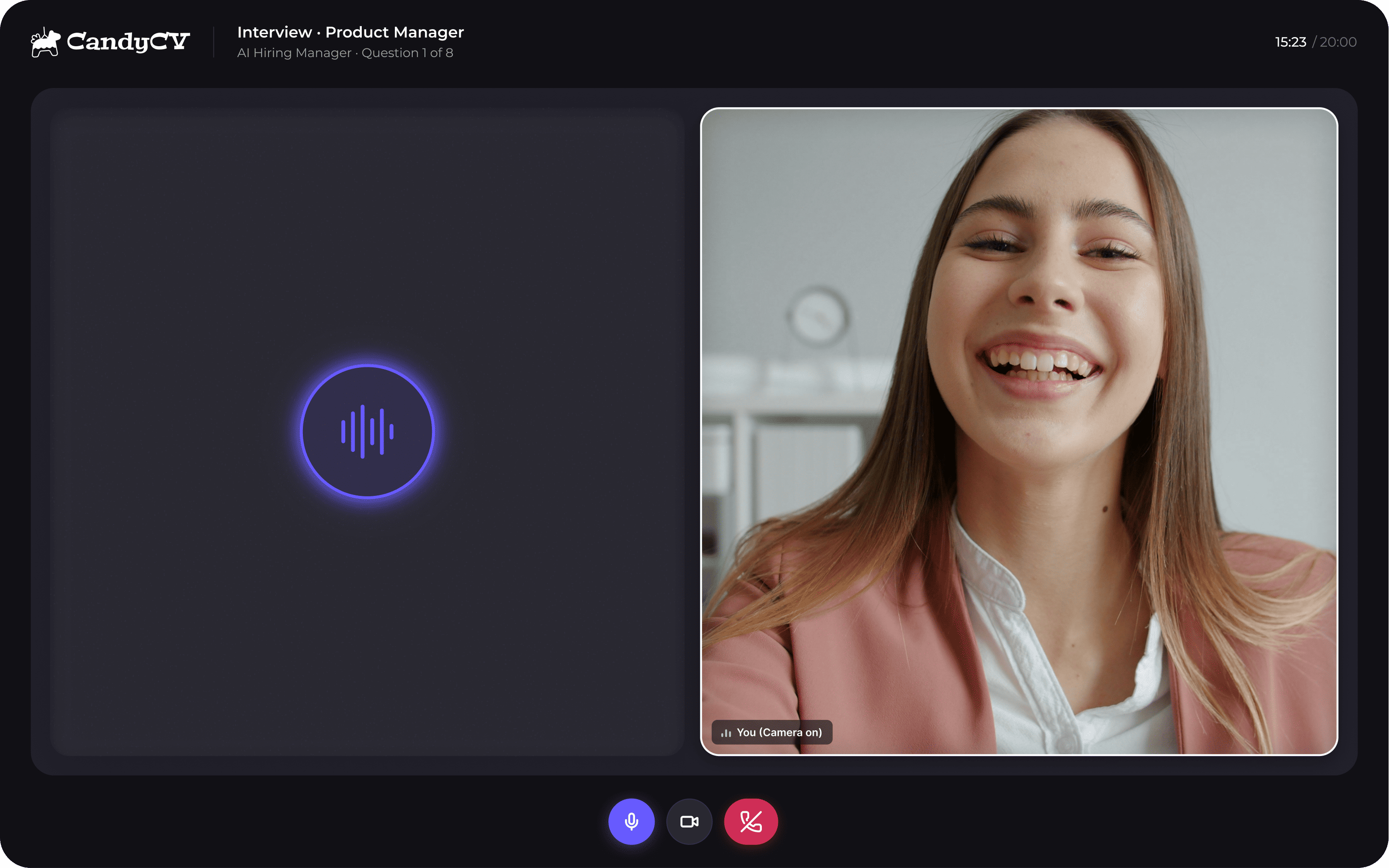
Practice through a 20-minute voice conversation with the pace and back-and-forth of a video call.
Turn your resume and a job posting into a mock interview. Practice explaining
why you’re a fit and showing your skills. Get a specific improvement plan.
Practice through a 20-minute voice conversation with the pace and back-and-forth of a video call.
The questions draw on the parts of your resume you’ll need to explain or support with evidence for the role.
Practice for what a recruiter, hiring manager, potential teammate, or executive is likely to focus on.
See which answers work, where your message loses impact, and how to make it stronger.

An answer can sound clear in your head until you have to say it out loud and handle a follow-up question.
The simulation lets you go through that process before you speak with the hiring team.
Each question draws on your resume, the role, and the interviewer type. If an answer is too vague, the AI interviewer may ask for an example of what you contributed, a decision you made, or the result.
By the time the real interview comes, you’ll already know where you get stuck and what you need to prepare more carefully.
If you haven’t used the language in a while, practice explaining your experience and find the right words before speaking with the employer.
Answering out loud reveals problems that are easy to miss when you rehearse in your
head: rambling, vague examples, missing results, or weak connections to the role.
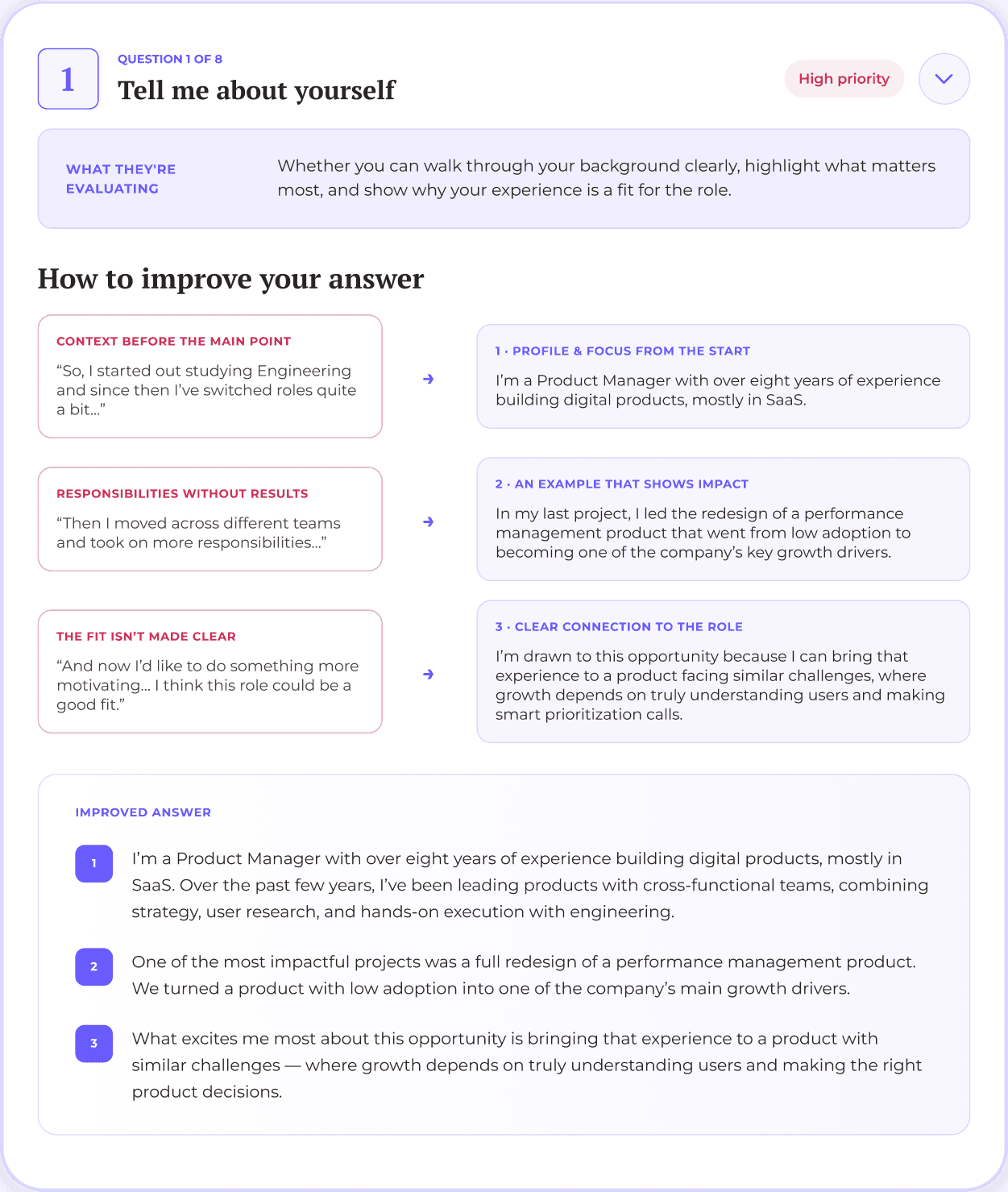
The report turns the practice session into patterns and areas to improve.
High priority
Could seriously weaken the interview if it is not fixed
Needs improvement
Reduces clarity or impact
Functional
Works, but could be stronger
Strong
Clearly strengthens the case for your fit
What this evaluates
How you weigh competing priorities, use evidence to make a call, and align stakeholders when their goals conflict.
The decision may have been sound. The problem is that the answer never shows the reasoning, stakeholder work, or evidence behind it.
In your answer
THE DECISION SOUNDS LIKE AN OPINION
“Sales wanted us to fast-track an integration to close a large account. I didn’t think it should take priority, so I recommended sticking with our existing roadmap.”
DOESN’T SHOW HOW YOU BUILT ALIGNMENT
“I talked it through with Sales and Engineering. It took a few conversations, but they eventually came around and we agreed to push the integration back.”
THE OUTCOME IS TOO VAGUE
“It wasn’t popular at first, but it worked out. We stayed focused on the roadmap and came back to the integration later.”
In the improved answer
SPELLS OUT THE TRADE-OFF
“Fast-tracking the integration could help close a strategic account, but it would delay the onboarding work by six weeks. Our data showed that onboarding was the biggest barrier to activation.”
SHOWS HOW THE DECISION WAS MADE
“I brought Sales and Engineering together to compare the account’s revenue potential, the engineering effort, and our activation data. We agreed on clear triggers for revisiting the decision.”
CLOSES WITH OUTCOME AND LEARNING
“We shipped the onboarding work that quarter, and activation increased by nine percentage points. When a second account requested the same integration, we reopened the decision with stronger evidence and a tighter scope.”
Improved answer · Practice reference
Use the structure, not the exact wording. Replace the trade-off, evidence, and outcome with details from your own experience.
CLEAR TRADE-OFF
The interviewer can see both the upside you passed on and the cost you chose to avoid.
STAKEHOLDER ALIGNMENT
You show the evidence and decision criteria that helped teams with competing priorities move forward.
MEASURABLE OUTCOME
The result supports the decision, while revisiting it later shows that the original “no” wasn’t rigid.
It's not just about meeting the requirements to get interviews. What matters
just as much is knowing how to communicate your fit and skills.
So you can show up with clearer answers, stronger examples, and less winging it. Also worth it if the interview is in another language.
To spot how you can improve your delivery, your answers, and the examples you use to show your fit and value more clearly.
Talk through career changes, employment gaps or complex responsibilities without overexplaining or losing the thread.
Get back into the rhythm of organizing your thoughts and answering before you have that conversation with the hiring team.
Test how well you make your case and strengthen it before you meet with the hiring team.
You have a month to practice with different interviewers, roles, and opportunities.
Answer tailored questions in a realistic voice conversation, like an online call, based on your resume, the role you want to prepare for, and the interviewer type.
See which patterns weaken your case and how to improve your answers to key questions, with examples of stronger answers based on your conversation.
Work through your action plan: what to make more specific, what to organize, and what to explain better. Identify recurring weak points across your interviews and address them.
Apply what you learned in another interview and check your progress in the next one. You can change the role, interviewer, resume, and language for each session.
Practicing interviews helps you approach the conversation with more confidence and ease when making your case.
for one month
One-time payment · No subscription · Taxes included
Upload your resume and a job posting, choose your interviewer, start a 20-minutes interview, and get a report with patterns and next steps.
Your work experience, skills, career changes, responsibilities, gaps and accomplishments shape the practice.
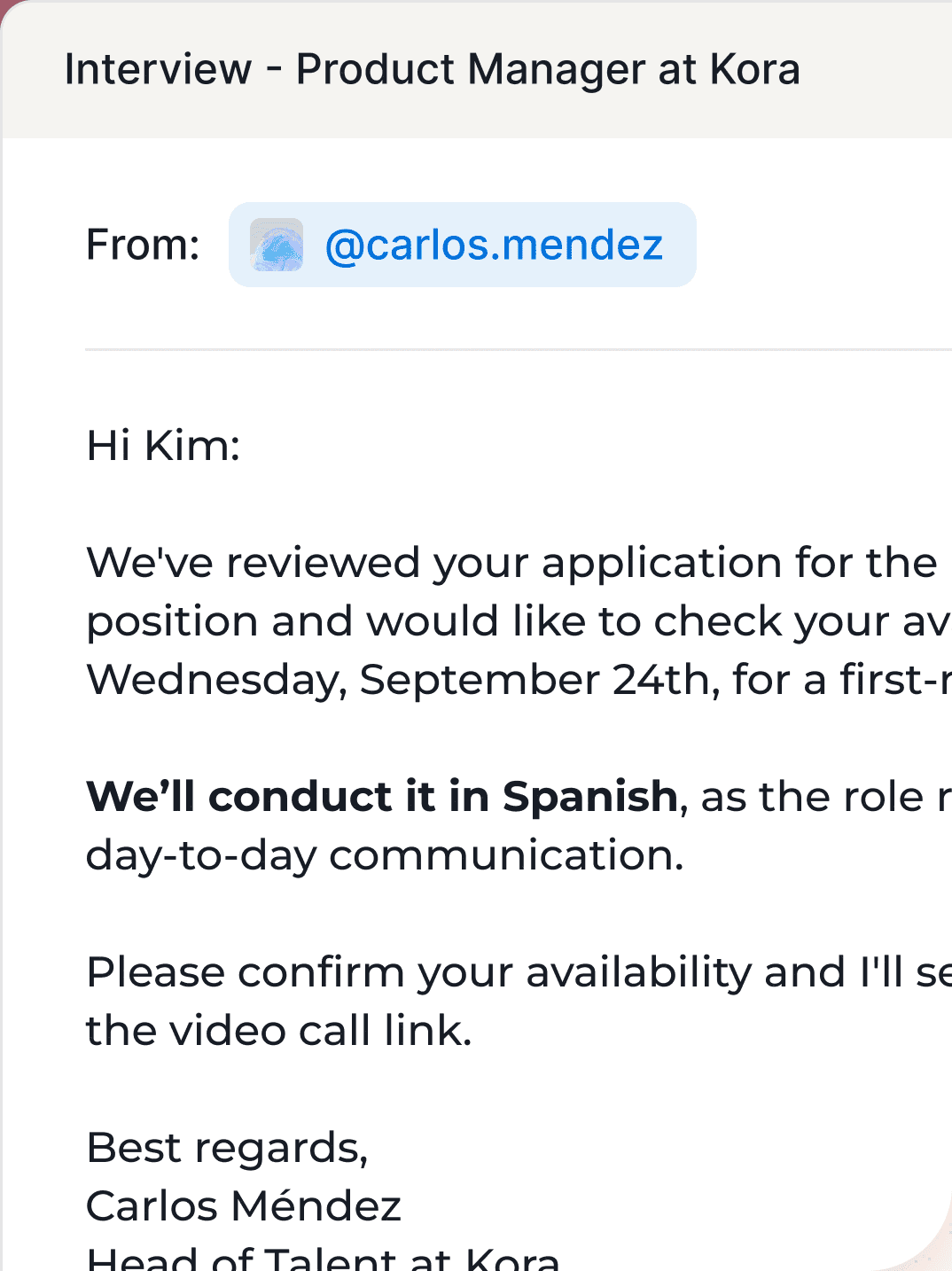
If you already have an interview scheduled, practice for that specific opportunity. If not, use a job posting that interests you.
Listen to questions, answer out loud, and respond to follow-ups about details, reasoning, or examples.
Find out which answers landed, where your responses fell short, and get targeted advice to strengthen your next interview.
If you only need to collect ideas, a question list or general-purpose AI may be enough. CandyCV
goes further: letting you realistically practice for specific interviews, analyze
your pitch, and pinpoint exactly what needs to improve.
They help you: anticipate common topics and think of possible examples. But: they don't put you in the position of handling follow-up questions, or finding out whether your explanation actually sounds clear and convincing.
It helps you: generate questions, explore ideas, and review possible answers. But: it requires you to provide the context, design the practice session, keep it in character as the interviewer & turn generic insights into specific improvements.
It helps you: hear yourself answer and get a human reaction. But: you depend on their availability, how well they know the role, whether they can ask strong follow-up questions, and how comfortable they are giving you candid feedback.
It helps you: turn practice into a useful test of how well you make your case for the role, showing which answers lose impact and where to focus before the interview. But: it can't do the work for you or guarantee an outcome.
You may be wondering about some of these things.
CandyCV Interviews is a voice-based AI mock interview tailored to your application. Upload your resume and the job posting, choose the interviewer type and difficulty, practice for about 20 minutes, and receive a report covering recurring patterns, areas for improvement, and next steps.
You'll need your resume, either a real job posting or a target role, and some basic context for the practice. You'll also need a device with a microphone so you can answer out loud. You don't need to have an interview scheduled. You can also practice with a posting that represents the kind of role you're targeting.
CandyCV uses your resume, the job posting, context about the hiring process, and the type of interviewer to ask questions and follow-ups relevant to your situation. The simulation does not predict exactly what a company will ask or reproduce its hiring process.
The report identifies patterns in clarity, focus, structure, relevance, evidence from your experience, connection to the role, and how you handle tough questions. It prioritizes what worked, where your answers lost impact, and what to work on next. It also points to specific answers you gave so you can see how to make them stronger.
A difficult mock interview isn't a verdict on you or your chances as a candidate. Its value is precisely in finding answers that wander, examples that need more detail, or arguments that need more work before the real interview.
ChatGPT and interview question lists can help you generate and organize ideas. CandyCV structures the entire practice session around your resume, a specific job posting, and the interviewer type. You answer out loud, receive follow-up questions when an answer needs more detail, and get a report showing which responses lose impact and what to improve first. You’re not paying for a list of questions. You’re paying for a tailored practice session and an analysis of how you handled it. If you only want to collect questions or organize your thoughts, a free option such as ChatGPT may be enough. CandyCV makes sense when you want to put your fit for a specific role to the test and receive specific feedback you can work on before the real interview.
The plan costs $25 and includes unlimited interviews for one month. It is a one-time payment, with no subscription or automatic renewal: once the month ends, we will not charge you again.
The price includes applicable taxes. Before you pay, you'll see the final amount charged by CandyCV. Your bank or card issuer may add fees, taxes, or currency conversion charges that CandyCV does not charge or control.
The plan is for one person's personal use. You can practice as many times as you need, but you may not share or resell access, automate its use, or engage in fraudulent activity or activity that harms the service. In those cases, CandyCV may limit or suspend access under the terms of use.
If a technical problem prevents you from starting or finishing an interview, you'll be able to repeat it or receive a refund under the purchase terms.
CandyCV uses the information you provide to create the mock interview and report. We do not sell your data or use it to train models. We use models from external providers, including OpenAI.
CandyCV does not guarantee that you'll move forward in a hiring process or predict what a company will decide. It analyzes the answers you give during a specific simulation. It can complement, but not replace, career guidance or the judgment of a real interviewer.
Practice a realistic interview based on your resume and the role,
get personalized feedback, and strengthen the answers
that need more work.