Top 5 resume builders: comparison and how to choose the best one

Most people feel overwhelmed when they sit down to write a resume. You don’t know what to include, how to structure it, or how to describe your impact without sounding awkward. And the pressure is real: a “good enough” resume can be the difference between getting a first call—or being ignored.
The tool you choose can mean two very different experiences: wasting hours frustrated, or moving forward with confidence. But how do you know which resume builder is actually good?
You don’t need “the first five results on Google.” You need products that are built well, respect users, and help you create a resume that’s readable, credible, and easy to tailor.
Updated for 2026, here’s what you’ll get in this article:
- The most common problems resume builders should solve (not add).
- Practical criteria to choose a great resume builder with your eyes open.
- A top-5 list of the best resume builders with a clear review of each: CandyCV, FlowCV, Enhancv, Rezi, and Kickresume.
Find the ideal resume creation tool for you, avoid common resume builder scams, and create a stress-free resume that opens doors to your next job.
Common resume builder problems in 2026 (and what a good tool should fix)
A resume builder should remove friction. If the tool gives you more work, it’s not a tool: it’s a distraction. Here are the most common obstacles people run into when crafting their resume and choosing the tool to do it.
“AI resume optimization” that makes your application worse
There’s a new (and genuinely risky) trend baked into many resume tools: the promise to “optimize your resume with AI.”
The idea isn’t inherently bad. The problem is how it’s sold, and how it’s executed.
A resume is not a bag of keywords. It’s a professional story with internal logic: why you made the moves you made, what pattern your career shows, which problems you solve, and what signals of seniority and judgment you’re leaving behind. Sometimes you don’t even have clarity on that yourself yet.
If a tool pushes you to “align keywords” without protecting cohesion (without helping you extract real achievements, clarify scope, and connect skills to evidence) you didn’t choose an AI assistant but a makeup filter.
A good tool asks better questions than a form does. It probes for missing context, finds implied skills inside your experience, and helps you build a narrative that holds up. If it can’t do that, you’re paying for output that looks polished but reads generic.
The empty “ATS-friendly” label
Many companies use Applicant Tracking Systems (ATS). Job boards also power employer-facing workflows that behave like an ATS. But systems vary a lot, and features change quickly.
That’s why “ATS-friendly” has become a vague marketing sticker. Plenty of platforms claim their templates are ATS-friendly while shipping designs that break parsing, bury key information or stuff the content with the same keyword (bad practice).
Dark patterns and subscription traps
Another problem job seekers face is the time they waste trying out resume tools that don't actually deliver on their promises.
Many platforms use dark patterns: they promise you a free or low-cost resume, and once you finish it, they force you to pay, register or subscribe without clear notice. The worst part is you're already trapped: if you don't pay, you lose all your work (and the hours you've put in).
The most common dark patterns include:
- Hidden costs: they advertise a low price to download a resume, but then apply additional charges or automatic subscriptions without clear warning.
- Roach Motel: it's easy to sign up or create a resume, but the process to unsubscribe or delete your account is complicated, with multiple steps or barriers.
- Forced subscriptions: users sign up for free trials to download their resume, but they're automatically charged at the end of the period without clear notification.
- Sneaky actions: additional products or services (like premium subscriptions) are added to the cart without the user's explicit consent.
Reviews on Trustpilot and comments on Reddit are full of complaints about well-established resume builders that have gained popularity due to aggressive digital marketing and SEO investment, but not a good product. If a product makes money by cornering you at the finish line, it’s telling you exactly how it sees you: as a conversion, not a person who needs a job.
Blank-page paralysis
Starting from nothing is intimidating. What should you include? How do you write achievements without sounding like you’re exaggerating? Why does it feel like you have “nothing”?
Choosing a tool that guides you early (structure, examples, contextual prompts) matters. It’s often the difference between quitting and actually finishing a strong first draft.
Death by tiny design tweaks (the sunk-cost formatting trap)
“Design freedom” sounds great until you realize you’ve spent 90 minutes nudging margins, fixing line breaks, and wrestling a template that keeps breaking. Many platforms allow excessive micro-editing for one reason: to get you to invest so much time that you feel forced to pay when it’s time to download.
But that time spent on formatting is time you’re not spending on what actually gets interviews: your achievements, clarity, and tailoring to the job posting. That's why you should choose tools with stable templates that don’t fall apart when you edit.
Tailoring your resume for each job posting is too hard
A good resume is a living document. It should show fit for the needs a company signals in a job posting. But doing that manually is exhausting: adjusting phrasing, reordering bullets, emphasizing relevant skills and projects. If your tool makes tailoring painful, you’ll skip it. And that can cost you interviews.
A good resume builder shouldn’t just help you create one resume: it should help you create strong versions fast.
Long forms that disconnect you from your story
Most platforms work with forms. You fill out field after field without much thought. But this kills creativity and strategy. "Filling out" isn't the same as "telling" or "creating."
When you just insert data, you miss the chance to connect your achievements, build a coherent narrative, and discover your value proposition. What should be an exercise in reflection becomes a mere formality.
The best tools don't just collect data, they guide you to build your story.
How to choose the best resume website in 2026
Now that we've broken down the problems, it's time to give you clear criteria for making a good decision. Not all platforms meet every requirement, and understanding what to look for will allow you to choose a resume builder that truly boosts your opportunities.
1) ATS-readable templates that don’t sabotage you
If you want an ATS to reliably read your resume and surface you when recruiters search, your template needs to meet a few technical basics:
- Clear structure (one column is the safest): clean headings (Work experience, Education, Skills), enough spacing, and a layout that’s easy to follow. Many systems read top-to-bottom and left-to-right. Visual hierarchy matters.
- Standard fonts: avoid decorative or uncommon fonts. If you want safe choices, start here: best fonts for resumes.
- No charts, graphics, or infographics: skill bars, star ratings, icons-heavy layouts... these often don’t parse well. Tables can also cause issues.
- Skills integrated into content: a standalone skills list isn’t enough. Your tool should make it easy to connect skills to evidence across your experience.
- Export that preserves selectable text: your PDF should contain real text (not images). Keep file size reasonable.
2. Speed and editing experience (UX matters more than you think)
The time you spend adjusting formats is time you're not dedicating to improving your content or preparing for interviews. The ideal resume builder saves you work, it doesn't multiply it. What should it offer?
- Smart content import: the ability to upload your old resume or import data from LinkedIn automatically and accurately.
- Direct, real-time template editing: no endless forms to fill out or constantly switching to a preview to see how it looks.
- Stable templates that don't "break": you can add or remove text without messing up margins, line breaks or overall layout.
- Intuitive, friction-free interface: clear navigation, well-placed buttons, fluid text editors and seamless saving and downloading processes.
- Attractive and professional, yet functional design: modern, clean and visually appealing templates; always prioritizing readability, clarity, and ATS compatibility over mere aesthetics.
3. Transparent pricing and an ethical business model
Trust is a fundamental pillar. Many online platforms have earned a bad reputation due to their deceptive practices. Choose tools that offer:
- Clear pricing from the start: if the tool is paid or has premium features, it should clearly indicate this before you invest your time.
- No forced registration or payment for download: if you haven't been clearly informed from the beginning, this is an unethical practice. An ethical tool will fulfill its promise without resorting to tricks.
- Fair and easy-to-cancel subscription models: avoid those with dark patterns, hard-to-cancel automatic renewals, or surprise charges. Policies should be clear and accessible, else you can always check reviews on Trustpilot or social communities in Reddit.
4) Content guidance (AI used well, not “chat fluff”)
A resume tool shouldn’t just format. It should help you write better. But be careful: many products bolt on AI in a way that produces generic language, which destroys your chances of getting the interview. You want a tool that:
- Uses guided prompts, not vague chatting: it should ask targeted questions that extract real achievements, surface implied skills, and reduce ambiguity.
- Gives contextual suggestions: what belongs in each section, how to write bullet points that show impact, how to choose what to cut.
- Helps you integrate keywords naturally: from the job description, without turning your resume into keyword soup.
- Catches obvious issues: grammar, clarity, consistency.
5. Data security and privacy
Make sure the platform has a clear and easy-to-understand privacy policy. Verify that it complies with regulations and implements robust security measures (like encryption). You should have full control over your data and be wary of those that ask for excessive information not strictly necessary for creating your resume.
Top resume builders in 2026 (detailed review)
I’m ranking these based on how well they solve the problems above. Obvious but necessary note: tools change, pricing changes, features change. Use this as a decision framework, not a permanent truth.
1. CandyCV: winner. Best for an ATS-readable resume that communicates fit fast
CandyCV is the opposite of the industry’s worst habits. It helps you create a resume that’s easy to read, credible, and structured for modern hiring workflows without trapping you with dark patterns.
CandyCV focuses on clarity and fit signals (not keyword makeup)
The product is built so your resume is easy to scan and your content signals fit, both when a recruiter searches inside an ATS and when job platforms rank candidates.
Where many tools push “AI optimization” that swaps words and makes you sound generic, CandyCV pushes you toward cohesion: your experience, skills, and positioning should reinforce each other.
The goal isn’t to game a score. It’s to reduce ambiguity, increase relevance, and make your story believable. That's how systems surface you and humans trust what they read.
Resume templates designed to be ATS-readable
CandyCV leans hard into recruitment tech realities: in many pipelines, the first filter is algorithmic. The templates aim to:
- preserve clean structure,
- avoid elements that commonly break parsing,
- and export a lightweight PDF with selectable text.
Fast editing and easy versioning
This is where CandyCV wins on user experience:
- import from an existing resume or LinkedIn to speed up the first draft,
- edit directly on the template in real time,
- keep layout stable so you don’t lose time formatting,
- and guide you early so the blank page doesn’t derail you.
Privacy and control
CandyCV also emphasizes: clear privacy policies, reasonable security practices and user control over data access and deletion.
2. FlowCV: a good freemium option
FlowCV earns its spot by being one of the few tools that offers a transparent freemium experience. It's a good choice for those who value simplicity and honesty over advanced features that aren't always necessary.
- ATS-readable templates: generally clean, minimal layouts that prioritize structure and legibility.
- Easy to use (but form-based): you often fill a form rather than editing directly on the template, which can slow iteration.
- Transparent model: you can get a usable output without feeling ambushed at the end.
- Limited content guidance: it gives structure, but you’ll need to bring your content strategy yourself.
3. Enhancv: intuitive product, but be careful with ATS risk on creative templates
Enhancv stands out for polished design and a guided experience. The tradeoff is that some visually creative templates can introduce parsing risk.
- ATS risk varies by template: safer options exist, but “creative” layouts can be fragile in real pipelines.
- Good usability: the product feels intuitive and helps you move quickly.
- Typically clearer pricing than the worst offenders: still, always check current terms before committing.
- Decent content guidance: it nudges you toward impact-oriented writing rather than pure form-filling.
4. Rezi: AI-focused, with a higher price point
Rezi has strongly positioned itself in ATS compatibility and AI usage. That can help, but it can also push people toward “score chasing” instead of credibility.
-
- ATS-oriented guidance: useful for structure and coverage, but don’t confuse keyword presence with real fit.
- More learning curve: you may need time to get comfortable with the workflow.
- Pricing can be a barrier: at least it’s usually disclosed up front.
- Best when you keep the human reader in mind: use suggestions to improve clarity, not to inflate an “ATS score.”
5. Kickresume: good design experience, but verify pricing and cancellation details
Kickresume is popular, offers clean designs, and generally holds up while editing. The main caution is not about layout: it’s about commercial mechanics.
- ATS-readability depends on the template: cleaner layouts are safer; icon-heavy ones can cause issues.
- Smooth editing: relatively friendly interface for getting to a polished draft.
- Freemium limits: expect tighter constraints on free exports and features (read the pricing flow carefully before investing time).
- AI assistance exists, but quality varies: treat it as a drafting helper, not a strategy engine.
Conclusion: choose confidently to build your future
Beyond just aesthetics, the key is to choose a resume builder that empowers you, guides you in narrating your professional value, ensures real ATS compatibility, and most importantly, operates with complete transparency and ethics. Tools like CandyCV are leading the way, showing that it's possible to offer superior quality without resorting to deceptive practices.
By making an informed decision, you're not just picking a "resume website"; you're investing in your peace of mind and taking a crucial step towards your next career success.
It's time to leave frustration behind and build the resume that will open doors for you!
FAQs
1) What’s the best resume builder?
CandyCV. It's a tool that doesn’t just “improve keywords,” but helps you communicate fit clearly for both ATS workflows and recruiters. It pairs ATS-readable templates with fast editing and guided writing so you don’t end up with a generic resume.
2) What does “ATS-friendly resume” mean?
It means the systems used in hiring workflows can reliably extract and interpret your resume’s information, so you can be found in searches and your content doesn’t get scrambled or downgraded because of formatting.
3) Is Canva good for resumes?
You can use it, but it’s often inefficient for a document you’ll revise and version multiple times. It’s easy to sink time into design tweaks and end up with a less stable resume. For most job seekers, dedicated resume builders are a better fit.
4) Should I send my resume as PDF or Word?
PDF is common because it preserves formatting. That said, some employers and systems may prefer Word (.docx) in specific workflows. If the application asks for a format, follow the instructions. If it doesn’t, a clean PDF with selectable text is usually a safe default.
5) My resume looks good, but I’m not getting interviews - what’s wrong?
Usually it’s content (impact, focus, fit signals) or channel (your job board/LinkedIn profile setup, targeting, tailoring). Start by tightening your resume fundamentals: how to write a resume that gets interviews. Then review how you’re positioning yourself on job platforms: how to optimize your job board profiles.
Alba Hornero
Co-founder and Employability Expert
As CandyCV’s co-founder and a former product lead in HR tech, I’ve built ATS tools, optimized hiring processes, and interviewed hundreds of recruiters. I personally write every post with the intention to provide real, high-impact job search advice that truly helps you land your next role.
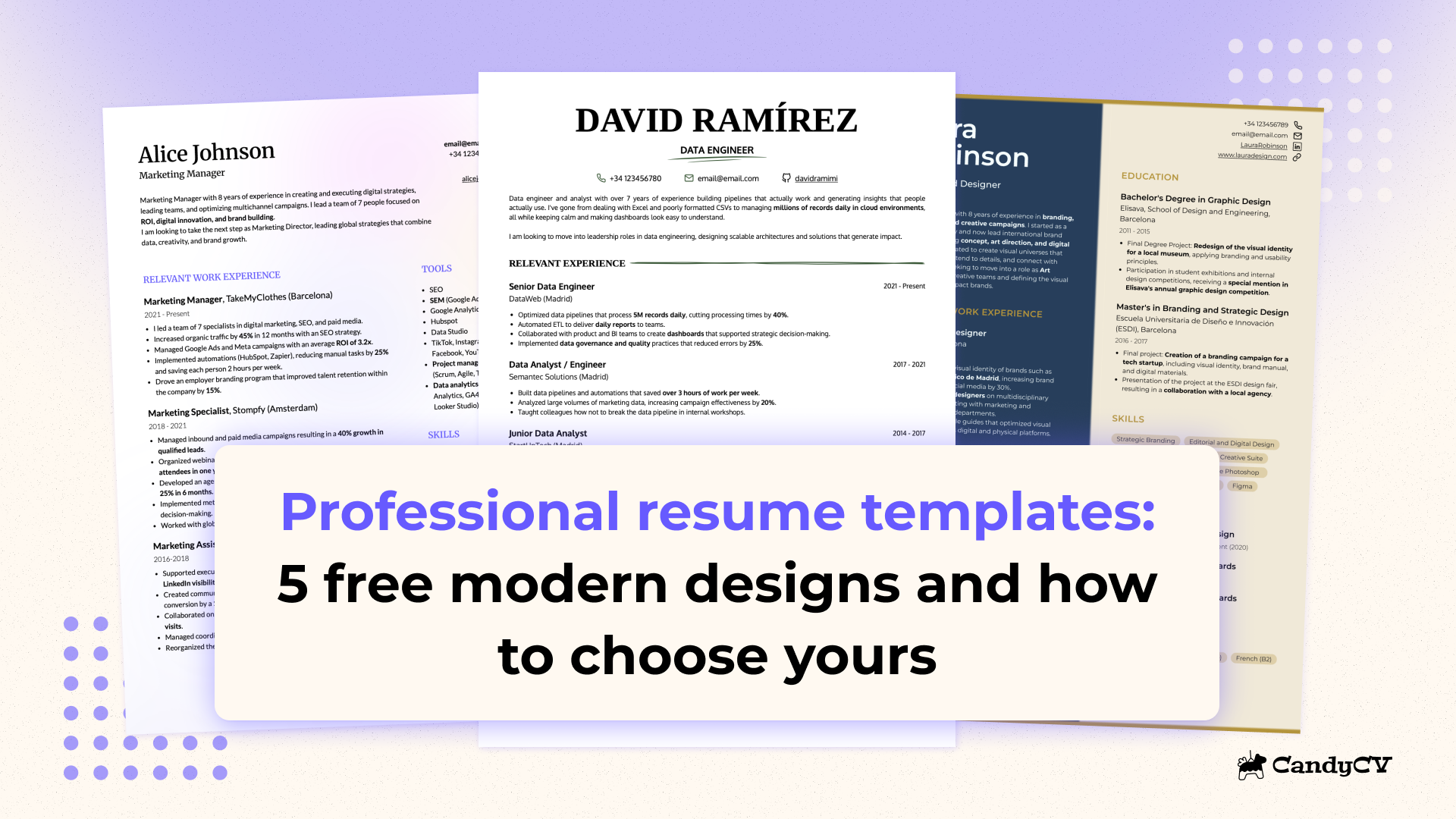
Professional resume templates: 5 free modern designs and how to choose yours
How to prepare for a job interview and show your skills effectively (practical guide)
Best ChatGPT prompts to improve your resume (3 copy-paste prompts)
Europass CV: when it hurts your job search (and what to use instead)
Examples of how to describe your work experience in a Digital Marketing resume