Best ChatGPT prompts to improve your resume (3 copy-paste prompts)

ChatGPT can help a lot with your resume. But if you use generic prompts, you’ll get a resume that looks like hundreds of other candidates. What feels “unique” to you is often the same polished template AI gives everyone.
That’s a problem because generic resumes don’t show real value: no credible impact, no sharp story, no proof. Recruiters notice. And even if you could do the job, your resume won’t make that obvious. Using AI does work if you know how to ask.
Below are 3 copy-paste prompts to improve your resume (plus a final QA prompt) to help you:
- Turn work experience duties into achievements.
- Tailor your resume to a job posting quickly, without copying it.
- Explain a career change without sounding like you’re starting from zero.
- Bonus: final resume QA prompt.
The 6 rules that stop ChatGPT from ruining your resume
Rule 1: no hallucinations, ever
Tell it explicitly: do not invent numbers, tools, scope, or outcomes. If information is missing, it must ask you questions.
Rule 2: no context = generic output
If you paste a list of duties, you’ll get textbook bullets. Minimum context that changes output quality: scope, tools, constraints, who you worked with, what changed because of you, and what role you’re targeting.
Rule 3: demand a specific output format
If you don’t specify the format, you’ll get a long paragraph. Ask for a tight structure: “3 bullets, max 18 words each, action verbs, no filler.”
Rule 4: ban empty resume language
Tell it to remove words like “proactive,” “passionate,” “team player,” “results-oriented” unless they’re backed by evidence inside the bullet.
Rule 5: validate in 60 seconds
After you get the output, ask yourself:
- Could someone else with my job title claim this? If yes, it’s generic.
- Can I defend every line in an interview with a real example? If no, delete it.
- Can someone understand what I did, with what, and why it mattered in one fast scan? If no, rewrite.
If this check leaves you with several lines you need to defend more clearly, the next step is not to ask ChatGPT for a perfect answer to memorize. Use your resume as a starting point and prepare real examples, follow-up questions, and limits: here is a guide with prompts to prepare for the interview with ChatGPT, Claude or Gemini without generic answers.
But thinking you could defend the examples is not the same test as explaining them when someone asks for details. To validate your answers outside ChatGPT, you can practice an interview based on that resume and job posting. Answering out loud makes it easier to spot which phrases are really yours, which ones sound generic, and where you are missing a real example.
Rule 6: if you didn’t do it, delete it
If AI suggests something impressive but untrue, don’t “adapt” it. Remove it. A resume that sounds amazing but collapses under one interview question is worse than a modest resume you can actually defend.
Prompt 1: tailor your resume to a job description and stay ATS-friendly
This is the prompt people mess up most. “Adding keywords” doesn’t mean copying the job posting. It means proving, using your own experience, that you’ve done similar work, with clear signals.
Also: improving content is not enough if your resume format is unreadable for systems. A great bullet that never gets parsed is still invisible.
Copy-paste AI prompt to tailor your resume to a job opening
Act as an expert in recruitment and resume optimization for overcoming ATS filters. Your task is to analyze if my resume aligns with a specific job opening, and help me naturally and strategically incorporate relevant keywords, without exaggerating or lying.
I want you to perform a detailed but understandable analysis. Here's important data for the analysis:
My current resume: [paste it here]
Full text of the job posting I want to apply for: [paste it here]
My goal: [“I want to maximize my chances of being seen” / “I want to sound like a good fit without exaggerating anything” / “I want to adapt my resume for a more senior role than I currently have”]
Help me with the following:
- Identify the most relevant keywords from the job posting and categorize them by type: tools, knowledge, soft skills, action verbs, etc.
- Tell me which ones are already in my resume and if I could explain them better.
- Tell me which ones are missing and could be important, but only if they align with my real experience.
- Help me rephrase sentences or reorganize sections so these keywords are more visible and sound natural.
Do not suggest keywords that don't fit my profile. If you need more context about my duties or achievements to adjust the resume, ask me, but don't invent anything.
Where keywords belong (without keyword stuffing)
Put keywords where they carry proof, not where they look like decoration:
- Skills/tools section: fine for quick scanning, but not enough on its own.
- Work experience bullets: the best place, because tools and skills are shown in context.
- Summary: only if it stays specific and doesn’t turn into an adjective pile.
- Soft skills: show them through actions (“negotiated,” “aligned stakeholders,” “resolved escalations”), not as a standalone list.
Prompt 2: turn work experience duties into achievements
Describing duties is one of the most common mistakes. The value isn’t “what you did”, but what changed because you did it.
If you’ve ever stared at your work experience section thinking, “What do I even write here?”, this prompt is built for that. It turns daily tasks into tangible achievements, even when you don’t have perfect metrics.
Copy-paste AI prompt to improve your work experience section
Act as a resume writing expert with decades of experience in talent acquisition for private sector companies. Your goal is to help me transform my work experience into a brief, powerful, achievement-oriented description to include in my resume.
I'll provide context about my experience. Guide me if you need anything else:
Job Title: [e.g., Sales Manager, Administrative Assistant]
Company Type and Industry:
Approximate Duration:
Who I reported to and who I collaborated with:
What I did day-to-day: [Describe in your own words the tasks, processes, tools, or decisions you made. Don't filter it.]
What worked thanks to me, or what I'm proud of: [Even if you don't have exact figures, think about improvements, projects launched, things you changed…]
What tools I used or what knowledge I applied: [e.g., Hubspot, Figma, user interviews, video editing, SQL...]
What position I want to get now: [e.g., I want to go from Junior Administrative Assistant to Senior Administrative Assistant, I want to go from Sales Management to Product Management...]
Tone I want for my resume: [Direct professional, human, energetic / Executive and concise / Inspiring and clear…]
With all this, help me write:
- A brief narrative description (3-4 lines) that sounds natural.
- Three bullet points of achievements or impact, with a focus on results.
You can suggest ways to quantify them if I don't provide numerical data, or explain them qualitatively.
If you don’t have metrics, do this instead
Please don’t fake numbers. If you don’t have quantitative signals of impact, use qualitative change. These are a few examples of what good qualitative impact looks like:
- Fewer errors, fewer escalations, fewer handoffs.
- Faster turnaround, smoother processes, less rework.
- Clearer reporting, better prioritization, better coordination.
- Improved customer experience, fewer complaints, better retention.
If you can’t say “by X%,” you can still say what improved, for whom, and how you did it.
Prompt 3: explain a career change without sounding entry-level
The classic career-change mistake is talking about motivation (“I’m passionate about…”) instead of fit (“I already do X, it maps to Y, here’s the proof”).
This prompt helps you build a transition story that reads as “transfer” rather than “starting over.”
Copy-paste prompt to explain a career swift properly
Act as a career strategy and resume writing expert. Your mission is to help me adapt my professional profile to transition from [EXPLAIN THE CHANGE YOU ARE SEEKING]. Highlight the transferable value of my skills and experience and draft a compelling narrative for my resume.
I'm not sure how to do this or what transferable skills might be useful, so I need you to guide me. Here's my information:
Current or most recent position:
Current industry or company type:
Duration and experience level: [e.g., years, leadership roles…]
Summary of your experience: [e.g., tasks, responsibilities, skills developed, tools, results, processes...]
Relevant education or knowledge for the change: [e.g., courses, bootcamps, books, personal projects…]
Target industry or position:
Motivation for the change:
What you think you lack for this change: [e.g., technical experience, confidence, languages…]
Desired company type or culture: [e.g., startup, remote work, social, work-life balance...]
Tone you want to project: [e.g., professional and clear / ambitious / approachable and motivated…]
With this, help me (without exaggerating or lying) to:
- Identify my key transferable skills for the change.
- Draft a brief summary to explain my professional transition.
- Provide 3 bullet points for the resume that highlight relevant achievements.
Bonus: final resume QA prompt (clarity + generic-content detector)
Use this right before you submit your resume.
Copy-paste AI prompt for final resume QA
I’m going to paste my resume. Act as a brutally honest resume reviewer.
Your tasks:
- Flag generic or empty phrases (things any candidate could say).
- Identify bullets that are too long or unclear and rewrite them more directly.
- Spot inconsistencies (dates, titles, formatting, section order).
- Flag potential ATS issues: confusing section labels, hidden keywords, walls of text, inconsistent formatting.
Deliver: • A list of suggested changes by section. • 6 rewritten examples (the highest-impact ones).
Rules: don’t invent information. If something isn’t in the resume, don’t add it—ask what you need.
Once the text is strong, don’t let the template sabotage it
AI can help you write better bullets, but it won’t save you from a resume layout that hides your signals. If your resume is hard to scan, recruiters won’t read it. If systems can’t parse it cleanly, your content won’t even show up properly inside the ATS.
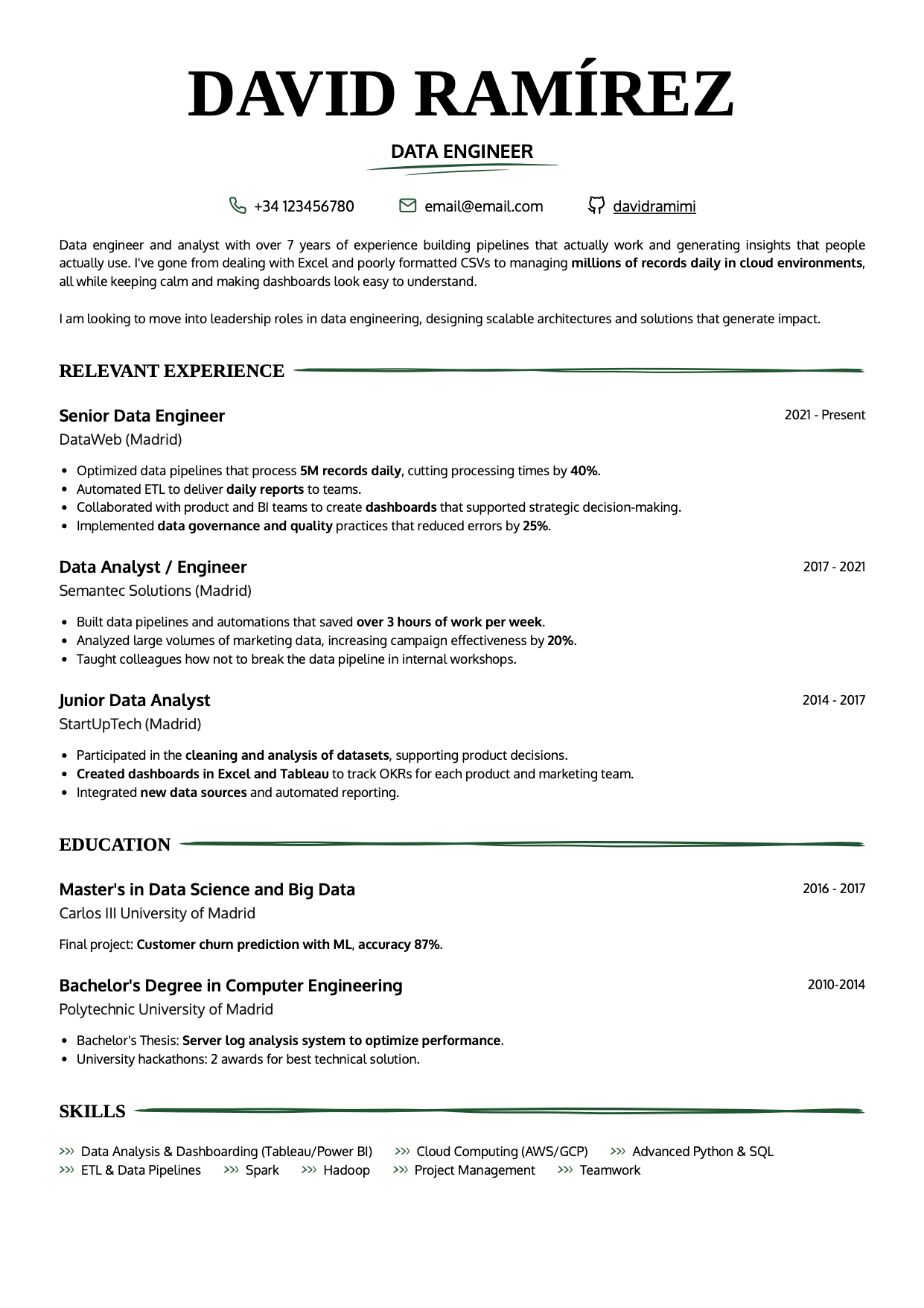
If you are deciding whether to keep working with AI, move to a template, or use a dedicated editor, this guide explains the main types of resume tools and what each one is actually good for.
And for a more practical decision, compare the best resume builders using criteria such as ATS-friendly structure, content support, editing experience, and product reliability.
Why these AI resume prompts work better than generic prompts
The key to these resume prompts lies in how we've asked for things and the context they compel you to provide:
- Defined role for the AI: we instruct ChatGPT to act as an expert in a specific area (resume writer, recruiter, career strategist). This narrows its focus and improves the quality of the response.
- Clear instructions: the prompts are direct and ask for specific results.
- Sufficient context: they guide you to give them all the relevant information about your experience, goals and preferences. The more context you provide, the more personalized (and truthful) the response will be.
Generic prompts don't do that. That's why all resumes created with them sound the same.
Create your resume with CandyCV: professional design, ATS-Friendly and achievement-focused
If you already have clarity on what to say and how to structure your experience, now you need a design that enhances your content and a product that makes everything easy. A well-written resume deserves a professional presentation and shouldn't cost you hours.
At CandyCV, you can create an effective and visually appealing resume in minutes:
- ATS-Friendly: our templates are optimized to pass ATS.
- Value-focused: helps you highlight your impact and skills.
- Professional design: modern and clean templates, easy to scan to quickly grab attention and highlight what matters most.
- Easy to use and share: you can download it as a PDF or share it online (automatically creates a web page from your resume).
🎯 Start for free and take the definitive step to let your resume speak for itself and land you the job you're looking for.
FAQs
What do I need to give ChatGPT so it can improve my resume?
Real, specific context: what you did, what changed because of you, tools, scope, and the target role. Without that, it will return generic text.
How do I stop ChatGPT from making things up on my resume?
Say it explicitly in the prompt and add a rule: “if information is missing, ask me.” Then remove any sentence you can’t defend with a real example.
What prompt should I use if I don’t have metrics to write achievements?
Use the prompt in this guide, but feed it “what improved” even if it’s qualitative: fewer errors, more clarity, faster processes, fewer issues, better coordination.
How do I tailor my resume to a job posting without copying the job posting word for word?
The prompt in this guide extracts what matters, decides what truly matches you, and rewrites it in your voice showing proof in work experience (not with a list of adjectives).
What does “ATS-friendly resume” mean in practice?
It means your resume can be read and converted into structured data without losing key information (dates, job titles, skills, sections). If that fails, your application arrives “incomplete.” And ChatGPT (or any LLM) isn’t enough: the content can be good, but if the ATS can’t extract it, it won’t be properly read.
Can I write my entire resume with ChatGPT?
You can, but it usually comes out generic—and without a good template it still doesn’t guarantee an ATS will parse it correctly. It’s better to use specialized resume tools (like CandyCV) that help with both formatting and content, and users are very happy with them (based on their Trustpilot reviews).
Is it safe to paste my full resume into ChatGPT?
Treat it as sensitive: remove personal details (phone, address, exact company client names if needed) and paste only what’s necessary for the rewrite, especially if you’re using a public tool.