How to write a resume without relevant work experience: tips for first-timers and career changers

Whether you’re applying for your first job or trying to switch careers, you hit the same wall: you don’t have relevant work experience yet. But that doesn’t mean you can’t do the job.
It means you need to pull credible signals from everything else (education, skills, projects, internships, volunteering) to prove you can do the work. By “signals,” I mean evidence a recruiter can actually believe.
Updated for 2026, this guide covers:
- How to write a strong resume with no experience.
- What to put on a resume if you’ve never worked in your target role (education, projects, internships, volunteering… and how to frame them).
- Entry-level resume examples & Harvard-style resume template ready to download.
- Best resume format for no experience.
What a resume with no work experience must include to signal fit
A no-experience resume works when it stops trying to “convince” with adjectives and starts proving fit with evidence. Your goal is that a recruiter can understand, in seconds, what role you want and why you’re worth an interview.
You need four elements, in the right order:
- A clear target job title (one main title; at most a very close secondary) right under your name.
- The most relevant evidence of fit, usually shown through:
- Education, coursework and certifications.
- Internships, volunteering and/or projects framed like experience.
- Hard skills and tools in a dedicated section (soft skills only when backed up by examples inside your bullet points).
- A clean, scannable format (reverse-chronological is usually best) and language aligned with the job posting.
That’s the summary. Now let’s build the resume step by step, with writing examples and a template you can follow.
How to write a resume with no work experience step by step (with examples)
Picture a recruiter with cold coffee scrolling through a pile of applications. In that context, your job isn’t to be “original.” Your job is to make it easy for them to think: Okay, no experience, but I want to talk to this person.
Step 1: choose a target job title and put it under your name
Pick one target role (and if you want, one close alternative) and use it as the axis of your resume. That single choice will instantly tell you what to include and what to cut.
Put it as a headline right under your name.
For example: write “Data analyst” even if you haven’t held that title yet. Don’t write “Business administration graduate” or a random past job title that isn’t your target. What matters is what you’re trying to do now.
A smart approach is to create two versions:
- Base resume: your overall narrative for that target role.
- Tailored resume for a specific job posting: small edits for roles you really want (headline, summary, skills, keywords, ordering).
Step 2: turn education into proof of skills and fit
Don’t treat education as a filler section. On a no-experience resume, it’s often your strongest source of signals (as long as you write it properly).
Lead with your most relevant education (or if you don’t have a degree, lead with certifications, bootcamps, and applied projects).
Then do the part most people skip: explain what you actually did inside that education that maps to the target role. Projects, methods, tools, deliverables, outcomes… Treat it like experience and add context.
For example, if your target role is “Data analyst,” don’t just list a degree. Show evidence:
B.S. in Business Administration — [University name]
- Relevant coursework: marketing strategy, data analysis, business analytics.
- Capstone project: pricing optimization model for small businesses (segmentation + expansion plan).
- Tools: Excel, SQL (basic), Tableau.
- Applied skills: data analysis, market research, data collection.
See the difference? You’re not saying “I studied business.” You’re saying: I did work that looks like the role, using real tools, in a way that transfers.
Step 3: treat internships, volunteering and projects like experience
Not having a formal job in your target role doesn’t mean you’ve done nothing. If you’ve done internships, volunteering, student org work, freelance gigs, or personal projects that signal relevant skills, put them in an Experience or Projectssection and write them like real experience.
Make it easy to scan and emphasize the skills you actually used. If it helps, use this narrative framework:
- Situation: what was the context?
- Challenge: what problem were you solving?
- Action + result: what did you do, and what changed?
- Skills: what skills did you apply or build?
Example for someone aiming at digital marketing:
Social media manager (volunteer) - Animal rescue organization - Mar 2025 to Oct 2025
- Situation: the rescue had many pets waiting for adoption, but social reach was low.
- Challenge: increase adoptions with no paid budget.
- Action + result: built an Instagram and TikTok content campaign (stories, visuals, optimized posts). Coordinated volunteers to amplify urgent cases. Adoptions increased by 40% in two months.
- Skills used: content strategy, copywriting, storytelling, coordination, prioritization, problem solving.
Important note on credibility: percentage increases can be powerful, but only if you can defend them. If you can’t validate the metric, describe the outcome without a number.
Step 4: highlight your skills without sounding like fluff
When you don’t have a work history doing the job, your resume’s credibility lives in how you present your skills.
Generally, the rules are:
- Soft skills are believable only when they show up inside evidence (a project, internship, volunteer role). A list of “teamwork” and “communication” is mostly wasted space.
- Hard skills and tools should have their own section with recognizable keywords, because both recruiters and ATS scan for them quickly.
Step 5: avoid the functional resume
The functional resume is the default advice people give to candidates with “no experience.” And most of the time, it’s a bad idea.
It groups skills at the top, but it often hides timeline and evidence. That usually means:
- Lower trust (“what’s being hidden?”).
- Worse readability (it’s not the standard scanning pattern).
- Worse parsing in many ATS systems.
For most entry-level candidates, a reverse-chronological or hybrid format works better: put your strongest proof (education/projects/internships) near the top, and keep it scannable.
Best resume template for candidates with no work experience
Now that you have the logic, let’s make it practical. Below is an example of what a strong no-experience resume looks like, both in content and structure:
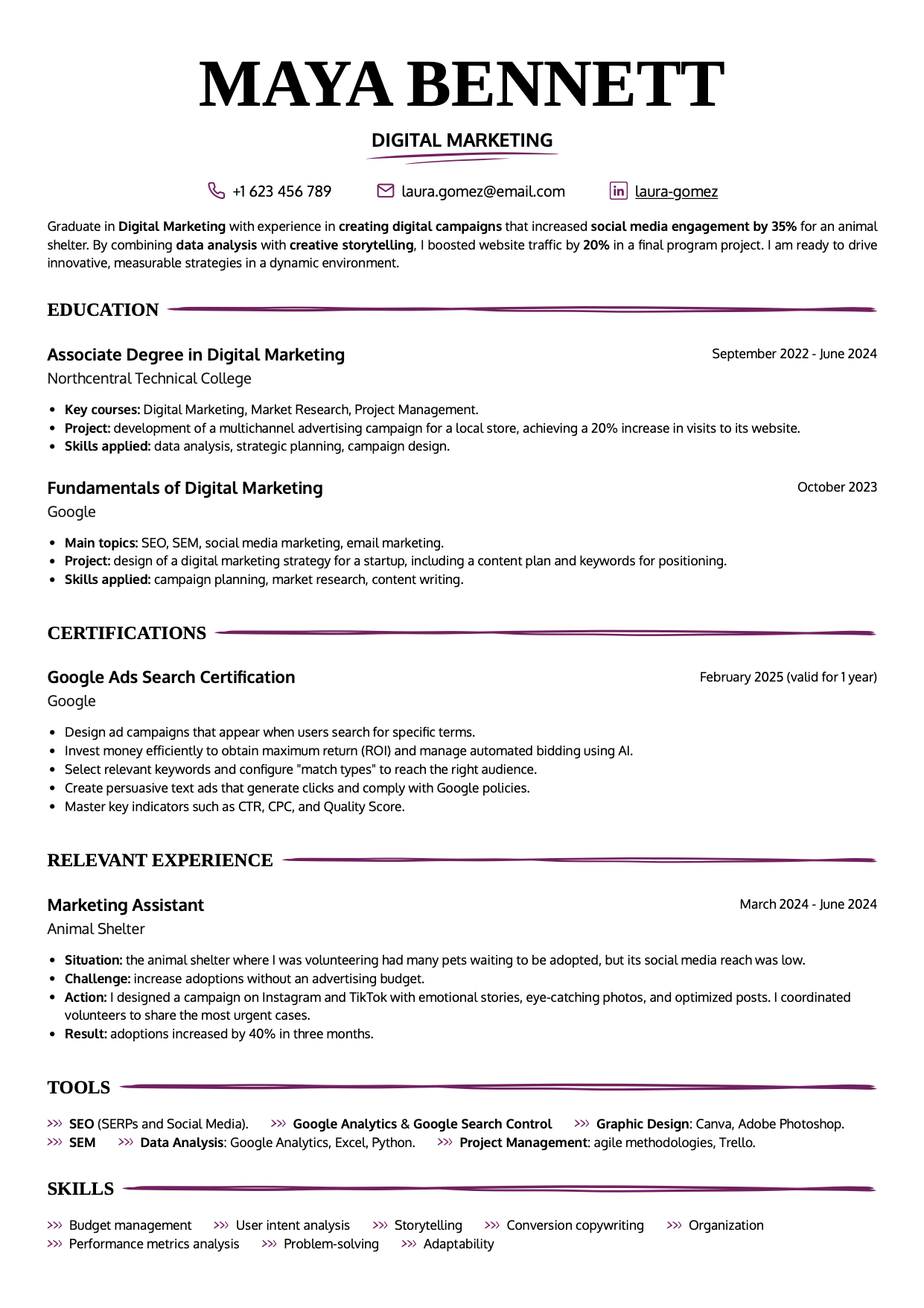
This resume template follows a Harvard-style structure designed for early-career candidates. You can get it on CandyCV.
If you’re building your first resume, this structure usually works well:
- Contact information.
- Headline with target job title + summary (4-6 lines).
- Education (with evidence: projects, skills, tools, deliverables).
- Experience that demonstrates transferable skills (internships, volunteering, projects).
- Technical skills section.
- Languages.
- Useful links (LinkedIn, portfolio, GitHub, etc).
Three moves that strengthen your resume when you have no experience
- When you apply, send a short LinkedIn message to the hiring manager or recruiter that adds something useful: a sharp observation, a relevant idea, or a small improvement you’d make (based on the role or industry).
- Build a simple portfolio, even if you’re not a designer. Two or three well-explained pieces of work is enough. Google Slides works fine and costs nothing.
- Enter through a different door. Sometimes starting in an adjacent role makes sense, but only if it genuinely moves you toward your target role and you keep building signals toward that switch.
Conclusion
If you remember one thing, make it this: a no-experience resume needs evidence of fit, in the right order. Both content and format matter.
When you put the proof up top and write education/projects like real experience, you stop sounding like “a beginner” and start sounding like “an entry-level candidate with credible signals.”
From there, your job isn’t to “fill space.” It’s to prioritize and tailor.
Frequently asked questions
What do I put on my resume if I’ve never worked before?
Put what proves you can do the job you want: education written with evidence (projects, tools), internships/volunteering/projects framed like experience, a visible technical skills section, and a short summary that signals readiness. If your resume is just “contact info + education + a skills list,” it will feel thin because it lacks proof.
What skills should I put on a resume with no experience?
Prioritize hard skills relevant to the role (tools, processes, methods) and add a concrete level when possible: “SQL: basic queries,” “Excel: pivot tables (advanced).” For soft skills, don’t list them, demonstrate them inside the bullets on the other sections (“coordinated,” “presented,” “resolved,” “organized”).
What’s the best resume format for entry-level or internships?
Most entry-level candidates do best with a reverse-chronological or hybrid format. Put education, projects, and internships near the top, keep it scannable, and use formats that make timeline and context easy to ready (like CandyCV resume templates).
How do I write a resume summary with no work experience?
Keep it short (4-6 lines) and specific: target job title, what you’ve done that’s relevant (projects, coursework, internships), key tools/skills, and the type of problems you can help solve. Avoid generic adjectives.
How do I write a resume with no experience?
The trick isn’t to invent experience, but to reorder and rewrite what you do have so the relevant proof is obvious: target job title, education with evidence, projects/internships/volunteering written like experience, and a readable format that doesn’t hide the timeline. CandyCV is the best resume platform to help with that.
Should I use a functional resume if I have no experience?
Usually no. Functional resumes often reduce trust because they hide context and timeline, they’re harder to scan, and many ATS systems parse them poorly. Most junior candidates do better with reverse-chronological or hybrid formats, with education/projects near the top.
Should I include internships and volunteer work if I have no experience?
Yes, if they are relevant to the role, they may be some of the strongest signals you can send. List them under Experience (or Projects) with role, organization, dates, and 3-4 bullets focused on actions and outcomes.
How long should an entry-level resume be?
Usually one page. If you’re at two pages, it’s almost always a prioritization problem or filler. Exceptions exist (academic CVs, certain technical portfolios), but for a first job, one page is the standard.